
How to Choose a Portable Trade Show Display
Posted by Kira on Oct 8th 2026
How to Choose a Portable Trade Show Display
A portable trade show display should make the event easier to manage, not just make the booth look better.
The right system depends on what the display needs to do, how often it will travel and how much hardware you are prepared to move, store and assemble.
A retractable banner stand, pop up wall, tension fabric backdrop, folding SEG frame and folding light box can all be described as portable displays, but they solve very different problems.
A useful way to choose is to start with the job the display needs to perform.
| Need | Display Type to Consider |
|---|---|
| Compact supporting graphics | Retractable Banner Stand |
| Simple portable backdrop | Pop Up Display |
| Large continuous fabric graphic | Tension Fabric / EZ Fabric Backwall |
| Portable SEG graphic system | Folding SEG Frame |
| Portable illuminated display | Folding Light Box |
| Multiple future configurations | Modular SEG System |
The goal is not to find the display with the most features.
It is to choose the simplest system that meets the project's visual and operational requirements.
Start With the Amount of Display Space You Need
The first question is not which frame technology you prefer.
It is:
How much branded surface do you actually need?
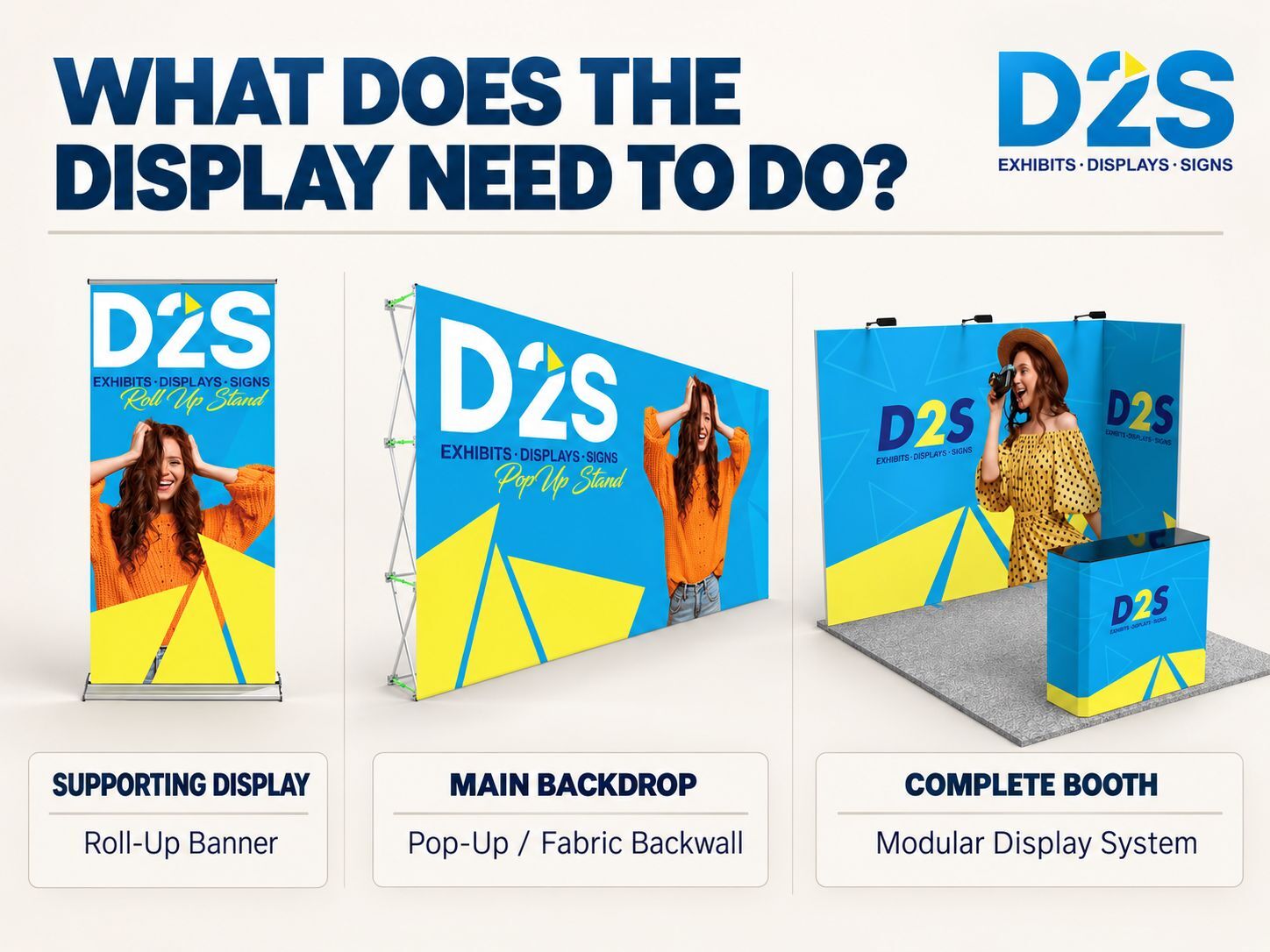
Portable trade show displays can generally be divided into three roles.
Supporting Display
A supporting display adds a specific message without becoming the main booth structure.
Examples include:
-
Product promotions
-
Service highlights
-
Directional messaging
-
Entrance graphics
For this role, a Retractable Banner Stand is often enough.
It uses little floor width, can be repositioned easily and works well alongside a larger backdrop or counter.
If you are deciding between common banner widths, read What Size Retractable Banner Stand Do You Need?.
Main Backdrop
If the display needs to create the primary visual wall, a larger portable backdrop is usually more appropriate.
This could include:
-
Pop up display
-
EZ fabric backwall
-
Tension fabric wall
-
Folding SEG frame
These systems create more graphic coverage than a narrow banner stand and can function as the main background in a standard trade show booth.
If width is still being planned, see What Size Trade Show Backdrop Do You Need?.
Complete Booth Environment
Once the project requires:
-
Multiple connected walls
-
Corners
-
Storage
-
Different booth layouts
-
Integrated counters
-
Larger illuminated structures
you are moving beyond a simple portable display and into a modular booth system.
At that point, frame compatibility and future reconfiguration become more important than minimizing the number of components.
Choose a Retractable Banner When You Need Compact Portability
A retractable banner stand is one of the simplest portable display formats.
The printed graphic rolls into the base when the stand is packed and extends vertically when the display is in use.
Its main advantage is not large graphic coverage.
It is compact deployment.
A retractable banner works well when:
-
Floor space is limited
-
The display needs to move frequently
-
One product or message needs to be highlighted
-
Several displays will be used around one event space
-
A main backdrop already exists
It is less suitable when the banner needs to create the complete visual background of a booth.
One or two narrow banner stands can support a 10x10 booth effectively, but several stands placed side by side usually do not create the same visual continuity as a proper backdrop.
Display2Sign offers multiple Roll Up Banner sizes for portable event graphics.
Choose a Pop Up Display When You Need a Simple Portable Backdrop
A pop up display uses a collapsible frame that expands into a larger display structure.
Its main strength is straightforward deployment.
Instead of assembling multiple individual frame profiles, the connected structure expands and supports the graphic surface.
A pop up display makes sense when:
-
You need one main backdrop
-
Compact packing matters
-
Setup should remain simple
-
The basic layout will stay consistent
-
You do not need a highly modular booth system
This makes pop up displays useful for standardized event programs.
A company using approximately the same backdrop at every event may get more value from a simple collapsible frame than from a more complex modular solution.
However, the advantage becomes smaller when the booth needs to change shape frequently.
If the same hardware must become different wall configurations at different events, other systems may provide more flexibility.
For a detailed explanation of the structure, read What Is a Pop Up Display? A Complete Guide.
You can also explore available portable options within Display2Sign Fabric Displays.
Choose a Tension Fabric Backwall When Graphic Area Matters
A tension fabric display is a strong choice when you want a large, continuous graphic surface without the visual interruption of multiple narrow displays.
Typical systems use a tube or frame structure with a fabric graphic stretched over or around it.
This format works well for:
-
Main booth backdrops
-
Corporate events
-
Branded photo backgrounds
-
Conferences
-
Product launches
The graphic itself is one of the main advantages.
Large fabric surfaces can create a cleaner overall presentation than combining several smaller display units.
Display2Sign Fabric Displays include EZ fabric walls, stands, pop up displays and other portable textile display formats.
A tension fabric backdrop is particularly useful when the priority is:
large graphic area + relatively lightweight hardware + straightforward transportation
rather than modular frame reconfiguration.
For more background on fabric display structures, see Tension Fabric Display Guide: Frames, Graphics & Benefits.
Choose a Folding SEG Frame When Graphic Finish and Reuse Matter
A folding SEG frame combines a portable folding aluminum structure with silicone edge graphics.
The silicone edge sewn around the graphic is inserted into a channel in the aluminum frame.
This creates a cleaner edge-to-edge appearance than many sleeve or panel-based portable systems.
The folding structure also reduces the amount of assembly required compared with conventional profile-based frames.
Choose a folding SEG frame when:
-
The display travels regularly
-
A clean SEG graphic finish is important
-
Graphics will be replaced over time
-
Hardware needs to be reused
-
The frame may later connect with compatible components
This makes the system particularly relevant to businesses managing repeated event projects rather than buying hardware for one event only.
The main advantage is the combination of:
portable structure + professional graphic finish + reusable frame
Display2Sign's SEG Folding Frame System includes individual frames and booth configurations designed around this type of reuse.
For the basic system structure, read What Is a Folding SEG Textile Frame Display?.
Choose a Folding Light Box When You Need Portable Illumination
Sometimes the decision becomes much easier because the display needs to light up.
A folding light box combines:
-
LED illumination
-
Fabric graphics
-
A folding frame
-
Portable transport
This gives it a different role from non-illuminated portable backwalls.
A folding light box makes sense when:
-
Backlighting contributes to the visual impact
-
The display needs to travel frequently
-
A standalone illuminated display is enough
-
Faster deployment matters
-
Storage volume needs to remain manageable
This can be particularly useful for product launches, premium brand graphics and event spaces where a conventional fabric backdrop may not provide enough visual emphasis.
Display2Sign Folding Light Boxes are designed for portable illuminated applications.
For a deeper explanation, read What Is a Folding Light Box? Portable Backlit Guide.
If you are deciding between folding and traditional assembled light boxes, see Folding Light Box vs Traditional Light Box: Which to Choose?.
How Often Will the Display Travel?
Usage frequency should influence the hardware decision.
A system that is acceptable for two events per year may become frustrating when it is installed every week.
For occasional use, the priority may simply be:
-
Finished appearance
-
Initial cost
-
Adequate portability
For frequent event use, operational details become much more important:
-
Number of components
-
Packed dimensions
-
Setup sequence
-
Replacement graphic process
-
Carrying bags or cases
-
Warehouse organization
The more frequently the display moves, the more value there is in reducing unnecessary assembly and loose hardware.
This is where retractable, pop up and folding systems often have an advantage over more complex structures.
Who Will Set Up the Display?
Installation responsibility is another important filter.
Ask whether the hardware will be handled by:
-
The exhibitor
-
Sales staff
-
A small event team
-
Professional installers
-
Rental company crews
If an end customer is expected to assemble the display without specialist support, simpler systems are usually preferable.
Retractable banners and pop up displays require relatively straightforward deployment.
Folding SEG frames and folding light boxes add more capability while still reducing some assembly steps through the folding structure.
Larger modular systems may be completely appropriate when trained installers are available, but unnecessary complexity can become a problem when the booth is repeatedly assembled by non-specialist staff.
Do You Need Illumination?
This question can eliminate several options immediately.
If the answer is no, consider:
-
Retractable banners
-
Pop up displays
-
Tension fabric backwalls
-
Folding SEG frames
If the answer is yes, consider:
-
Folding light boxes
-
Modular SEG light boxes
Do not add illumination automatically because it appears more premium.
LED lighting adds visual impact, but it also affects:
-
Power requirements
-
Packing
-
Hardware complexity
-
Component count
Lighting makes the most sense when it supports the booth objective.
For a supporting directional graphic, it may be unnecessary.
For the primary brand wall or a premium product launch, it may be much more valuable.
For a direct comparison of illuminated and non-illuminated SEG systems, read SEG Light Box vs Folding SEG Frame: Which Is Better?.
How Much Storage Space Do You Have?
Portable display selection should include the time the hardware spends outside the trade show.
For many businesses, equipment spends more time in:
-
Warehouses
-
Showrooms
-
Offices
-
Vehicles
than it does installed at an event.
Packed size therefore matters.
A retractable banner has a very small footprint.
A pop up frame collapses significantly compared with its installed size.
Tube-based tension fabric systems break down into smaller components.
Folding SEG frames and folding light boxes collapse while keeping much of the main structure connected.
Traditional modular systems may occupy more individual packages but can also be stored efficiently as standardized components.
The right answer depends on how inventory is managed.
How Often Will the Graphics Change?
Hardware and graphics do not always have the same useful life.
A frame may be used for several years while graphics change because of:
-
New product launches
-
Different events
-
Rebranding
-
Seasonal campaigns
-
Different customers
If frequent graphic replacement is expected, check the graphic attachment system before buying.
SEG systems are particularly useful when the same frame will continue to be used with new silicone edge graphics.
Tension fabric systems can also support replacement graphics, but graphic construction and installation differ by product.
Retractable banners may support graphic replacement depending on the cassette and hardware design.
The important point is to evaluate:
Can the graphic change without replacing the complete display?
For businesses managing repeat projects, that can significantly affect the long-term value of the hardware.
Will Your Booth Size Change?
This is one of the most important questions for B2B buyers.
If the same company always uses a similar 10x10 space, a fixed portable backdrop may be all that is required.
If the company moves between:
-
10x10 booths
-
10x20 booths
-
Conferences
-
Retail events
-
Larger custom exhibits
then reconfiguration becomes more valuable.
A single 10ft backdrop works well as a 10ft backdrop.
It does not necessarily solve a 20ft booth.
Several smaller compatible frames may be reused in more combinations.
This is why exhibit companies and rental programs often evaluate hardware differently from individual exhibitors.
For them, the question is not just:
“Does this work for this project?”
It is:
“How many future projects can use this hardware?”
One Large Display or Several Smaller Displays?
Both approaches can work.
One Large Display
Advantages:
-
Cleaner continuous graphic
-
Fewer visual breaks
-
Strong main focal point
-
Simpler overall message
Best suited to:
-
Main backdrops
-
Standardized booths
-
Large brand graphics
Several Smaller Displays
Advantages:
-
More layout flexibility
-
Separate messaging
-
Easier reuse across events
-
Individual components can be replaced or moved
Best suited to:
-
Multiple product messages
-
Rental inventory
-
Changing booth sizes
-
Supporting displays
For example, several narrow displays may work separately at small events and then be used together in a larger booth.
That flexibility can be more valuable than buying one large display that only works in one configuration.
Which Portable Display Is Best for a 10x10 Booth?
There is no single best system.
A practical 10x10 booth could use several different combinations.
Simple Portable Booth
-
8ft or 10ft fabric backdrop
-
One counter
-
One retractable banner
Best when portability and simplicity matter most.
Quick Pop Up Booth
-
Pop up display wall
-
Portable counter
-
Supporting banner stand
Best when fast deployment is the main priority.
Premium SEG Booth
-
Folding SEG backwall
-
SEG counter or supporting frame
Best when graphic finish and reusable hardware matter more.
Portable Illuminated Booth
-
Folding light box
-
Illuminated or standard counter
Best when backlighting is important but a complete modular light box booth is unnecessary.
The booth dimensions may be the same.
The correct display system changes according to the operating requirements.
Which Portable Display Is Best for Print Shops and Sign Companies?
Print shops should evaluate both the hardware and the graphic production workflow.
Important considerations include:
-
Graphic dimensions
-
Fabric finishing
-
Replacement graphic orders
-
Standardized hardware sizes
-
Storage
-
Customer setup difficulty
A system may look good at the event but create production problems if every order requires unusual graphic specifications.
Standardized portable hardware can make repeat production easier.
This is particularly valuable when the same display format is sold repeatedly with different printed graphics.
Which System Is Best for Rental Inventory?
Rental companies should focus on utilization rather than individual project appearance.
A useful rental display should:
-
Survive repeated handling
-
Pack efficiently
-
Accept replacement graphics
-
Be easy to identify in inventory
-
Work across multiple projects
Pop up displays can be effective for standardized backdrop rentals.
Retractable banners work well as supporting inventory.
Folding SEG frames provide more premium graphic presentation and can offer greater system flexibility.
Folding light boxes add an illuminated option without requiring every rental project to use a complete modular booth system.
The ideal inventory usually contains several categories rather than one universal display.
Portable Trade Show Display Selection Checklist
Before choosing a system, answer these questions:
-
Is this a supporting display, main backdrop or complete booth?
-
How much graphic area is needed?
-
How often will the hardware travel?
-
Who will install it?
-
Does it need LED illumination?
-
How much storage space is available?
-
How often will graphics change?
-
Will the booth size change between events?
-
Does the hardware need to work with other frames later?
These questions usually narrow the options quickly.
Quick Decision Guide
If you need the smallest and simplest supporting display, choose a retractable banner stand.
If you need a portable backdrop with straightforward setup, choose a pop up display.
If you need a large continuous fabric graphic, choose a tension fabric or EZ fabric backwall.
If you need portable hardware with a clean SEG graphic finish, choose a folding SEG frame.
If you need portable LED illumination, choose a folding light box.
If the hardware needs to support multiple booth configurations over time, move toward a modular SEG system.
Final Thoughts
There is no single portable trade show display that is best for every event.
A good choice depends on the role the display needs to perform and what happens to the hardware before and after the show.
For simple supporting graphics, a retractable banner may be enough.
For a standard portable backdrop, pop up or tension fabric systems can provide more graphic area without adding unnecessary complexity.
For a cleaner SEG presentation, folding frames offer a different level of graphic finish and reuse.
For illuminated branding, folding light boxes combine portable operation with LED visual impact.
And when future booth configurations matter more than minimizing setup components, modular systems provide more flexibility.
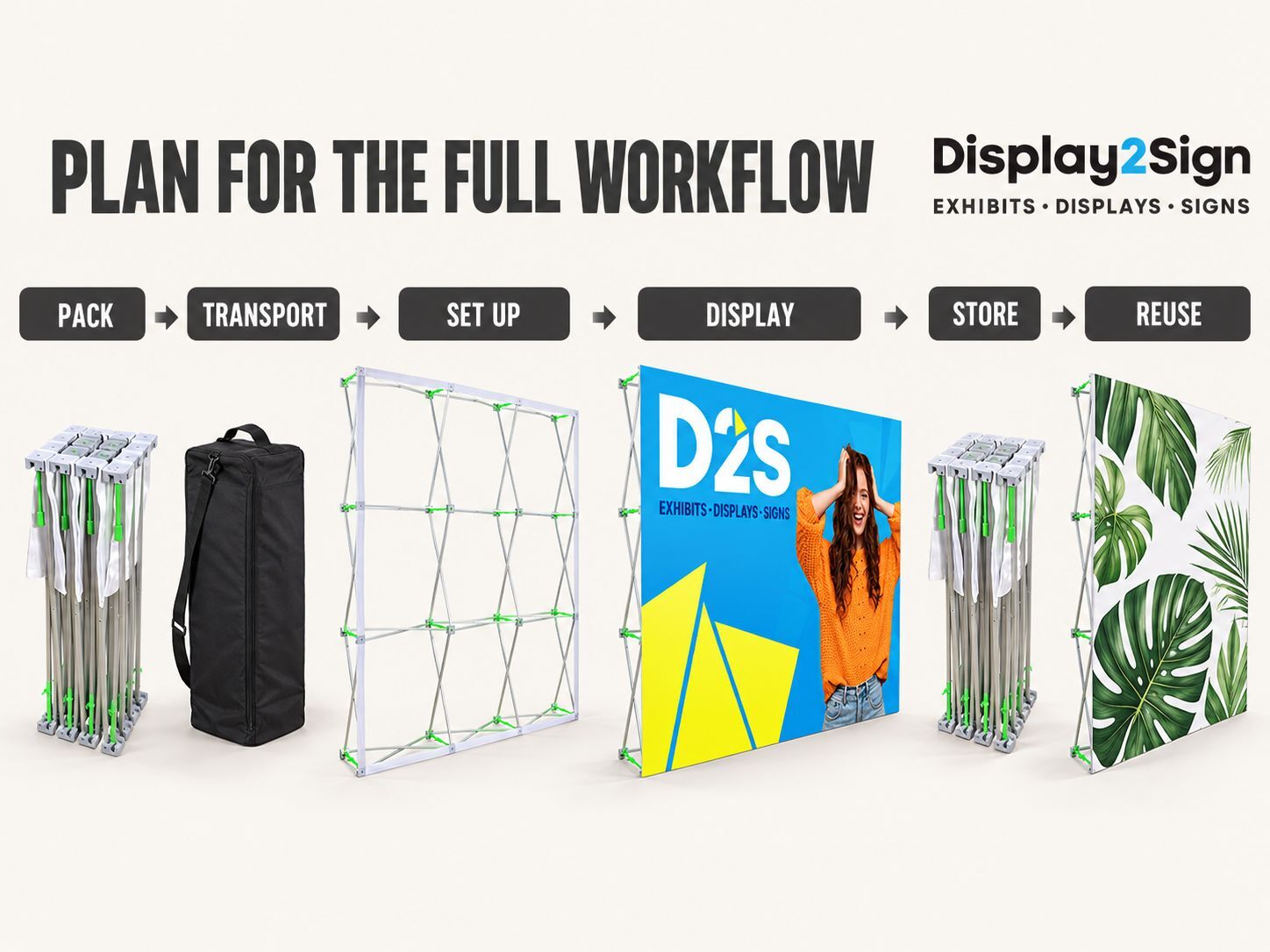
The most useful way to choose is to evaluate the complete workflow:
display requirement → transport → setup → event use → teardown → storage → graphic replacement → next project
Choose the system that makes that entire process easier—not simply the display that looks most impressive in one product image.
Explore Display2Sign Fabric Displays for portable backwalls, pop up displays and fabric systems, Roll Up Banners for compact promotional displays, Folding Light Boxes for portable illuminated graphics, or the SEG Folding Frame System for reusable SEG display configurations.