
Folding Light Box vs Traditional Light Box: Which to Choose?
Posted by Kira on Sep 16th 2026
Folding Light Box vs Traditional Light Box: Which to Choose?
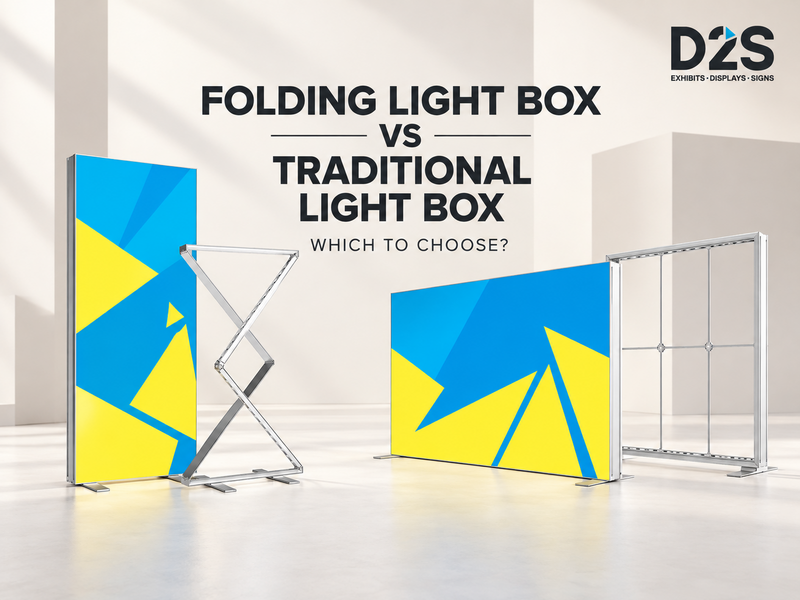
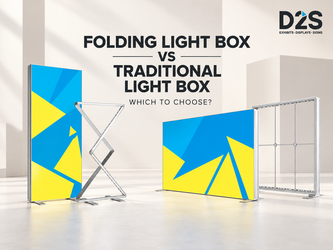
A folding light box and a traditional SEG light box can look very similar once they are installed.
Both use LED illumination behind a fabric graphic. Both can create a clean, high-impact backlit display. Both can be reused with replacement graphics.
The difference becomes much clearer when the display is taken down.
A folding light box keeps much of its frame connected and folds into a smaller format for transport.
A traditional SEG light box is usually assembled from separate frame profiles or modular sections and taken apart again for packing.
That structural difference affects almost everything that happens around the display: setup, packing, warehouse storage, transportation and how easily the hardware can be adapted to another project.
If you are buying hardware for repeated trade show use, those operational differences often matter more than the finished appearance.
Folding Light Box vs Traditional Light Box: Quick Comparison
| Feature | Folding Light Box | Traditional SEG Light Box |
|---|---|---|
| Lighting | LED backlit | LED backlit |
| Graphic | Tensioned fabric / SEG-style graphic | SEG fabric graphic |
| Frame | Folding structure | Assembled aluminum or modular frame |
| Setup | Open and secure frame | Connect frame sections |
| Loose components | Fewer | More |
| Packing | Compact folding format | Disassembled profiles/modules |
| Frequent transport | Strong advantage | Depends on system |
| Storage | Efficient for standalone units | Efficient when modules can stack |
| Reconfiguration | Usually limited | Stronger with modular systems |
| Best use | Portable standalone displays | Backwalls and modular exhibits |
The choice is therefore less about illumination and more about how the hardware needs to move and change over time.
The Main Difference Is the Frame Structure
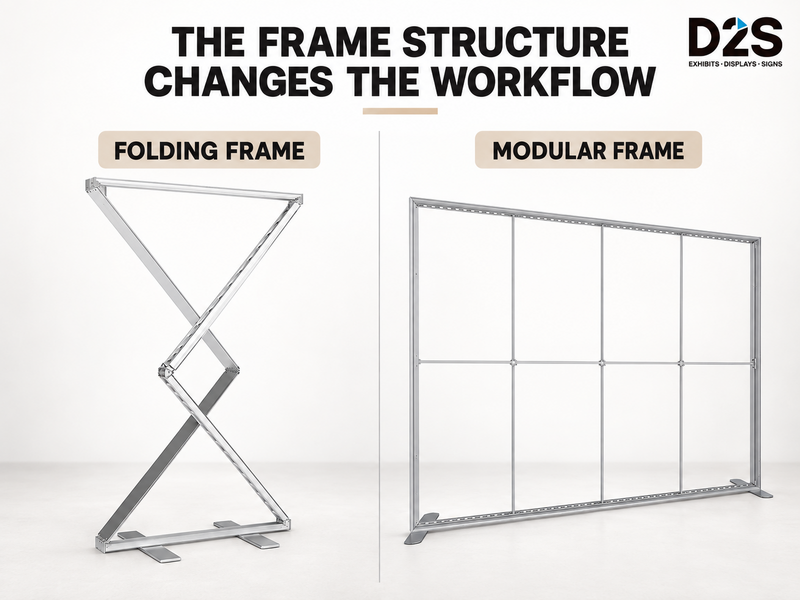
A folding light box is designed around repeated deployment.
The main frame remains connected when the display is packed. At the next event, the frame is opened, secured, fitted with the graphic and connected to power.
A traditional light box uses a different workflow.
Individual profiles, corners or modules are assembled to create the finished frame. After the event, these components are separated again for transport.
This approach involves more assembly, but it also makes it easier to design systems around interchangeable components.
That leads to the most important distinction:
Folding light boxes simplify deployment. Traditional modular light boxes provide more configuration flexibility.
Neither advantage automatically makes one system better for every project.
Which Light Box Is Faster to Set Up?
For a standalone display, the folding light box normally has the simpler workflow.
Much of the structure remains connected during transportation, so installers are not rebuilding the complete perimeter of the light box from individual frame sections.
This reduces:
-
Frame connection steps
-
Loose structural parts
-
Component sorting
-
Packing complexity
The difference becomes more valuable when the same display is installed frequently.
For example, a company running one permanent showroom installation may not care much whether the frame requires additional assembly.
A company moving the same display through ten or twenty events per year probably will.
The value of a folding structure increases with setup frequency.
If fast deployment is one of the main requirements, explore Display2Sign Folding Light Boxes.
For a detailed explanation of the format, see What Is a Folding Light Box? Portable Backlit Guide.
Which Is Easier to Transport?
A folding light box is generally easier to manage as an individual portable display.
Instead of packing several separate frame profiles, much of the structure folds into one connected unit.
That can make the hardware easier to move between:
-
Warehouse and vehicle
-
Vehicle and event venue
-
Multiple trade shows
-
Client installations
-
Temporary retail locations
Traditional light boxes can also be transported efficiently, particularly when they are designed as modular systems, but the packing logic is different.
Rather than folding the complete structure, the frame is broken down into components.
That can make sense when a company is transporting a larger booth rather than one standalone light box.
For example, ten modular sections packed together may be more useful than ten complete folding displays if those modules can be used to construct several different layouts.
So the transportation question should not simply be:
Which one packs smaller?
A better question is:
What exactly needs to be transported—the same display every time, or a collection of components used to build different displays?
Which Uses Less Storage Space?
For one standalone display, the folding light box has a clear operational advantage.
The structure collapses without requiring the hardware to be completely separated, helping keep the frame organized during storage.
This is particularly useful when:
-
Displays are frequently checked in and out of inventory
-
Different client graphics use the same hardware
-
Warehouse space is limited
-
Installers need to identify complete display sets quickly
Traditional modular light boxes can also use warehouse space efficiently, but they are better thought of as component inventory.
Frames, modules, connectors and accessories can be stored by type and then pulled for different projects.
That approach can be highly efficient for an exhibit company or rental operation, but it requires more inventory management.
A folding system simplifies storage at the display level.
A modular system can improve flexibility at the component level.
Which System Is Better for Repeated Trade Shows?
It depends on whether the repeated use involves the same display or different booth configurations.
Same display, different events
A folding light box is usually the more practical choice.
The hardware is opened, used, folded and stored repeatedly.
Graphics can be changed when branding changes, but the physical display format stays largely the same.
Typical examples include:
-
A company using the same backlit wall at multiple trade shows
-
A distributor traveling with a standard event display
-
A recurring product demonstration area
-
A portable showroom setup
Same hardware, different layouts
A modular traditional light box system becomes more attractive.
The components may be used for:
-
One straight wall this month
-
An L-shaped booth next month
-
A larger connected display later
-
A different client configuration after that
Display2Sign's modular SEG light box approach is designed around this type of reuse: the value comes from reconfiguring hardware rather than only reinstalling the same finished display.
Which Gives Better Visual Quality?
This is one area where the comparison is often exaggerated.
A folding light box does not automatically produce a lower-quality backlit graphic simply because the structure is portable.
Likewise, a traditional light box does not automatically look better because the frame is assembled from separate profiles.
The finished result depends on factors such as:
-
LED placement
-
Light diffusion
-
Graphic printing
-
Fabric tension
-
Frame depth
-
Graphic fit
-
Installation quality
If both systems are properly designed, both can produce a clean illuminated fabric display.
The real visual difference often comes from scale and configuration, not whether the frame folds.
A modular traditional system may support much larger connected illuminated environments.
A folding light box is more commonly used as a defined standalone display.
Which Is Better for a 10x10 Booth?
For a simple 10x10 booth that needs one illuminated backwall, a folding light box can be a very efficient solution.
It provides:
-
Backlit branding
-
A defined display footprint
-
Portable hardware
-
Less structural assembly
If the booth will consistently use the same layout, there may be little reason to carry a more complex modular system.
But the decision changes when the booth needs additional structure.
A traditional modular light box system becomes more useful when the 10x10 layout includes:
-
Connected illuminated walls
-
Corners
-
Storage areas
-
Counters
-
Multiple frame sections
-
Components that will later be reused in a 10x20 booth
At that point, you are no longer choosing only a backwall.
You are choosing a booth system.
Which Is Better for 10x20 and Larger Booths?
Larger exhibits generally increase the value of modularity.
A 20ft illuminated wall can theoretically be treated as one large display, but businesses that repeatedly build large booths often need more flexibility.
A modular system allows hardware to be divided into reusable sections.
Those sections may later be combined differently for another event.
This matters when booth requirements change between:
-
10x10
-
10x20
-
Corner layouts
-
Larger inline booths
-
Custom configurations
A folding light box still has a place in these environments, but it may work better as an individual illuminated element rather than the structural basis of the entire booth.
For larger reconfigurable exhibit applications, see Display2Sign's SEG Light Box System.
What About Replacement Graphics?
Both systems can support repeat use with new fabric graphics.
That means the hardware does not need to be replaced every time:
-
Branding changes
-
A new campaign launches
-
A product line changes
-
A different client uses the display
This is important because the useful life of the frame is often much longer than the useful life of the artwork.
However, buyers should confirm that replacement graphics are produced for the correct frame dimensions and graphic finishing method.
Even small differences in finished size or silicone edge placement can affect tension and fit.
The fact that two light boxes have the same nominal dimensions does not automatically mean their graphics are interchangeable.
Folding Light Box: When It Makes More Sense
Choose a folding light box when the project has a stable display format and operational efficiency matters most.
It is particularly suitable when:
-
The same display travels frequently
-
Fast setup is important
-
Storage needs to remain simple
-
Fewer loose frame components are preferred
-
A standalone illuminated backwall is enough
-
The hardware will be reused with replacement graphics
This is essentially a deployment-first decision.
The value comes from making the repeated cycle of transport, setup, teardown and storage easier.
Traditional Modular Light Box: When It Makes More Sense
Choose a traditional or modular SEG light box when the structure needs to do more than repeat one configuration.
It is a better fit when:
-
Multiple light boxes need to connect
-
Booth dimensions change between events
-
Hardware needs to support different layouts
-
Larger illuminated walls are required
-
Components will be managed as reusable inventory
-
Future expansion is important
This is a configuration-first decision.
The additional assembly is accepted because the hardware can support more layouts.
If you are comparing different SEG systems more broadly, read What Is an SEG Light Box and Which Type Should You Choose?.
What Should Exhibit and Rental Companies Consider?
For a one-time buyer, the finished display is usually the main concern.
For a business managing display inventory, the calculation is different.
Consider five questions.
1. How often will the frame move?
The more frequently it travels, the more valuable folding hardware becomes.
2. Will the finished size stay the same?
If yes, a folding system may avoid unnecessary assembly.
If no, modular components may provide more value.
3. Who handles installation?
If displays are regularly installed by small teams or end customers, reducing structural assembly can simplify deployment.
4. How is inventory stored?
Folding displays can be managed as complete units.
Modular light boxes are often better managed as component inventory.
5. Will future projects need different configurations?
This may be the deciding factor.
A folding light box is highly reusable when the display format remains consistent.
A modular system is more reusable when the required configuration changes.
Can You Use Folding and Traditional Light Boxes Together?
Yes.
A booth does not need to use one structural system exclusively.
For example, a modular illuminated wall may form the main booth structure while one or two folding light boxes are used as:
-
Freestanding product displays
-
Entrance graphics
-
Supporting branded elements
-
Displays reused later at smaller events
This can be more efficient than forcing every display requirement into one hardware system.
For companies managing multiple events, the practical goal is usually not to standardize every project around one frame.
It is to build an inventory where each type of hardware has a clear role.
How to Choose Between Them
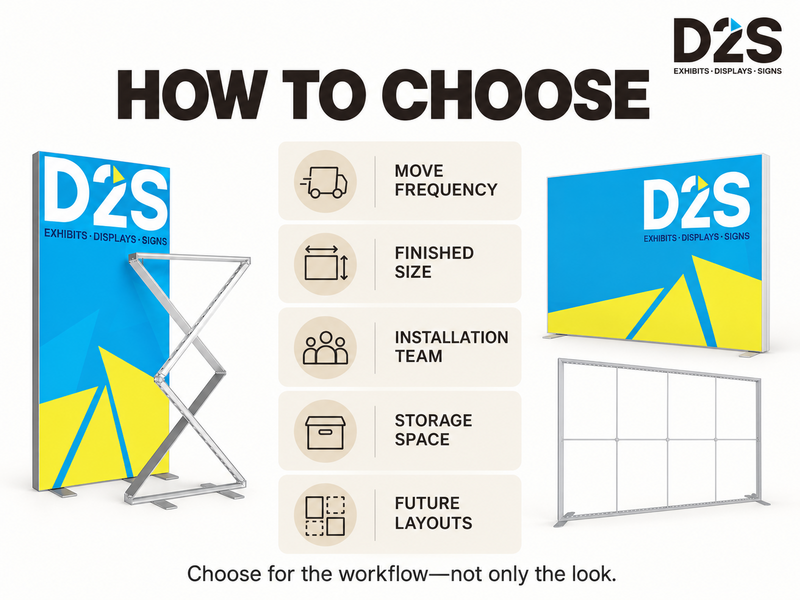
Use the workflow rather than the appearance to make the decision.
Choose a folding light box when you expect:
same format → frequent transport → fast setup → repeated reuse
Choose a traditional modular light box when you expect:
different layouts → connected structures → future expansion → component reuse
If both systems create the visual effect you need, the better choice is the one that reduces friction across the life of the hardware.
That includes:
packing → transportation → setup → event use → teardown → storage → next project
Final Thoughts
A folding light box and a traditional SEG light box can produce a similar illuminated graphic surface, but they are optimized for different workflows.
The folding light box keeps the structure connected so a standalone display can be moved and redeployed with less frame assembly.
The traditional modular light box uses separate structural components so the hardware can support more sizes and configurations.
For repeated use in a consistent format, folding hardware is usually the simpler operational choice.
For larger booths or projects where layouts change, modular light box hardware provides more room to reconfigure and expand.
If portability is the priority, explore Display2Sign Folding Light Boxes.
If you need reusable hardware for larger illuminated booth configurations, explore the SEG Light Box System.