
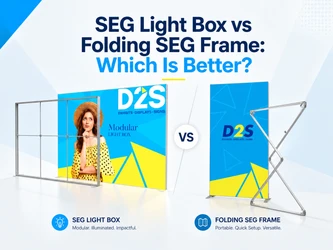
SEG Light Box vs Folding SEG Frame: Which Is Better?
Posted by Kira on Aug 28th 2026
Choosing between an SEG light box and a folding SEG frame is not simply a matter of deciding whether you want lighting.
Both systems use silicone edge graphics to create a clean, tensioned fabric surface, and both can be reused across multiple events. However, they are designed around different priorities.
An SEG light box is generally the better fit when illumination, visual impact and modular booth construction are important.
A folding SEG frame is usually the stronger choice when fast setup, compact storage and frequent transportation are the priority.
For exhibit companies, rental programs and businesses managing reusable display hardware, the right choice depends on how the system will actually be used from one project to the next.
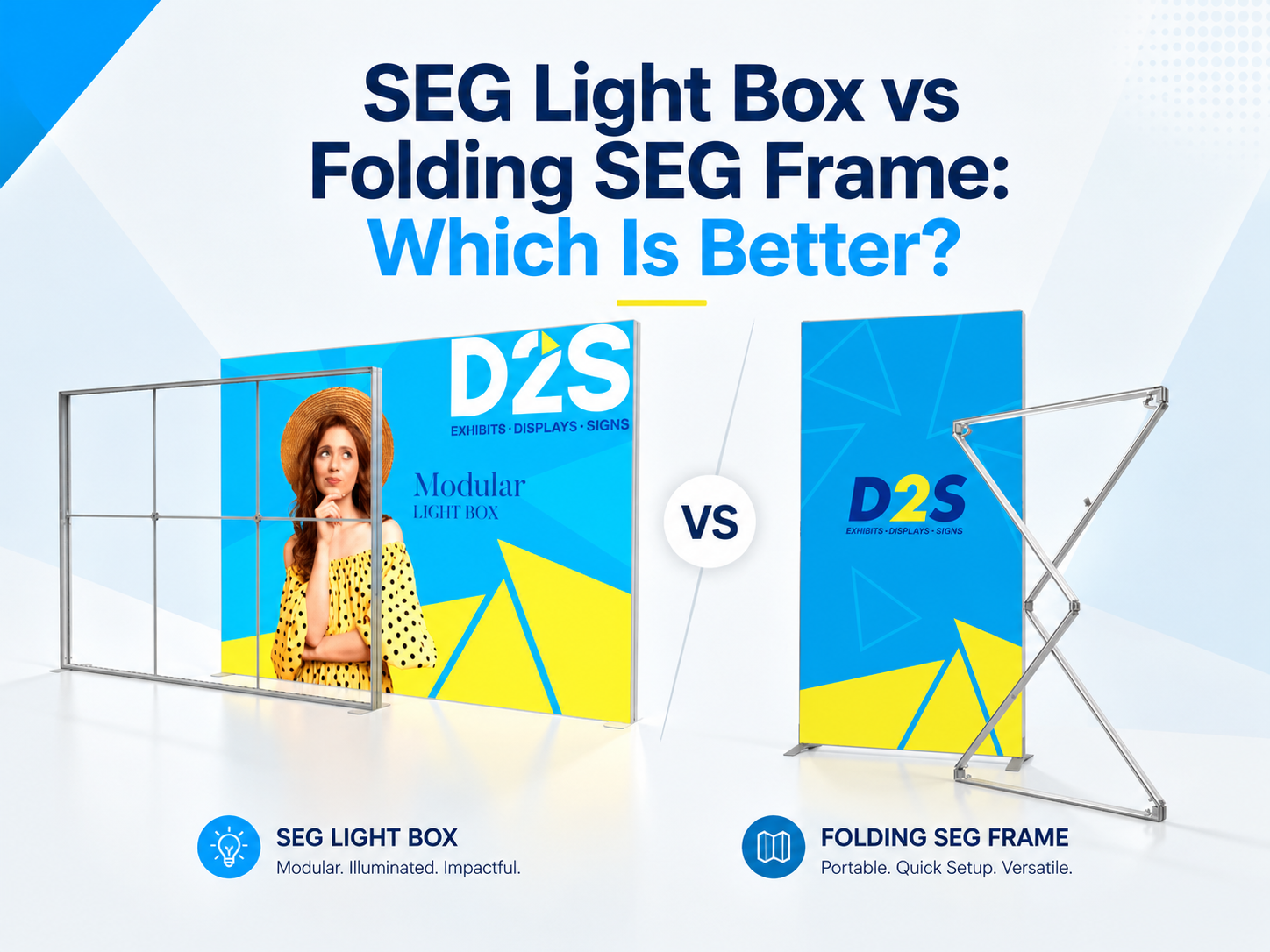
Quick Comparison: SEG Light Box vs Folding SEG Frame
| Feature | SEG Light Box | Folding SEG Frame |
|---|---|---|
| Graphic type | SEG fabric graphic | SEG fabric graphic |
| Illumination | LED illuminated | Non-illuminated |
| Visual impact | High, backlit presentation | Clean fabric presentation |
| Frame structure | Modular light box frame | Folding aluminum frame |
| Setup | Component-based assembly | Unfold and lock |
| Portability | Good | Excellent |
| Storage efficiency | Moderate | Excellent |
| Reconfiguration | Strong with compatible modules | Strong for portable layouts |
| Best suited for | Backlit walls and modular booths | Portable backwalls and reusable booths |
| Frequent event use | Good | Excellent |
The most important distinction is therefore not the graphic attachment method. Both can use SEG graphics.
The real difference is how the hardware is designed to support lighting, transportation, setup and booth configuration.
What Is an SEG Light Box?
An SEG light box is an illuminated display frame that holds a fabric graphic finished with a silicone edge.
The silicone strip is inserted into a channel around the frame, tensioning the fabric across the display surface. LEDs positioned inside the frame illuminate the graphic from behind, creating an evenly lit presentation.
If you are new to this type of display, read our complete guide: What Is an SEG Light Box and Which Type Should You Choose?
The Display2Sign SEG Light Box System is designed around modular frame hardware that can be used for standalone light boxes or combined into larger exhibit configurations.
This makes SEG light boxes particularly useful when a project requires more than a simple backwall.
Depending on the available frames, connectors and accessories, modular light box components can support configurations such as:
- Straight illuminated backwalls
- Corner booth layouts
- Connected light box walls
- Light box counters
- Larger modular exhibit structures
The lighting is an important advantage, but the modularity of the hardware can be just as important for businesses that reuse display components across different projects.
What Is a Folding SEG Frame?
A folding SEG frame uses the same basic silicone edge graphic concept but removes the internal illumination system.
Instead of assembling multiple frame sections for every event, the aluminum frame is designed to fold down for transportation and open into its display position when needed.
You can learn more about the structure in our guide: What Is a Folding SEG Textile Frame Display?
The main advantage is operational efficiency.
The frame can be unfolded, secured and prepared for the SEG graphic without assembling a large number of individual profile sections.
Display2Sign's SEG Folding Frame System can be used as individual backwalls or combined with compatible frames, connectors and supports to create larger booth layouts.
For businesses handling displays repeatedly, the folding structure can make transportation, setup and storage substantially easier.
What Is the Main Difference Between the Two Systems?
The simplest answer is:
SEG light boxes prioritize illumination and modular visual impact. Folding SEG frames prioritize portability and setup efficiency.
They should not necessarily be viewed as competing versions of exactly the same product.
They solve different project requirements.
A buyer asking for a highly visible illuminated booth may naturally move toward a light box system.
A buyer managing frequent events, multiple installations or compact transportation may place greater value on a folding frame.
Understanding that distinction makes the selection process much easier.
Which System Creates More Visual Impact?
If visual impact is the main priority, an SEG light box has the advantage.
Backlighting makes printed graphics brighter and helps the display remain visually prominent in exhibition halls where many booths compete for attention.
This can be particularly useful for:
- Main booth backwalls
- Product launches
- Premium branded environments
- Retail promotions
- High-traffic exhibition spaces
Illumination can also make large graphic surfaces feel more integrated into the overall booth design rather than functioning only as printed backgrounds.
A folding SEG frame does not provide internal illumination, but it still creates a clean, tensioned graphic surface with minimal visible hardware.
For many portable booths, that simpler presentation is exactly what is needed.
The choice therefore depends on whether lighting itself contributes enough value to justify the additional hardware and transportation requirements.
Which System Is Faster to Set Up?
For straightforward backwall installations, the folding SEG frame has a clear advantage.
The frame is designed to remain connected while folded. At the event, it can be opened and positioned without rebuilding the main frame from separate profiles.
That can reduce:
- Loose hardware
- Assembly steps
- Installation time
- Packing complexity
An SEG light box requires additional structural and electrical components because the display must support the lighting system.
Actual setup time varies according to the frame size and booth configuration, but a modular light box will generally involve more assembly than a comparable folding non-illuminated frame.
For installations where crews are repeatedly setting up and dismantling displays, these differences can become significant over time.
Which Is Easier to Transport and Store?
The folding SEG frame is usually the better choice when space efficiency matters.
Because the structure folds down, fewer separate frame sections need to be packed and managed.
This is particularly useful when display hardware moves frequently between:
- Warehouses
- Client locations
- Trade show venues
- Rental inventories
Compact storage can also become important for companies maintaining multiple identical frames.
An SEG light box contains more structural and lighting components. Modular construction still allows the hardware to be packed for transportation, but it will generally require more storage volume than a folding frame of a similar finished display size.
For one event, this difference may not be critical.
Across dozens of installations and multiple sets of hardware, it can become an important operational consideration.
Which Is Better for Reusable Booth Hardware?
Both systems are reusable, but they support reuse in different ways.
SEG Light Box
A modular light box system is valuable when the same hardware needs to support different booth configurations.
Compatible frames and accessories may be reorganized to create a new layout rather than purchasing a completely new booth for every project.
This makes the system attractive when configuration flexibility is the priority.
Folding SEG Frame
A folding frame is especially efficient when the same hardware is transported, installed, packed and stored repeatedly.
Graphics can be replaced while the frame continues to be used for different brands, campaigns or events.
This makes the system attractive when operational reuse is the priority.
For businesses managing rental inventory, the difference is worth considering.
One system helps maximize layout possibilities.
The other helps simplify repeated handling.
How Easy Is It to Replace the Graphics?
Both systems use SEG graphics, so the basic graphic replacement process is similar.
A silicone strip sewn around the fabric graphic is inserted into the corresponding channel in the frame.
When branding changes, the hardware can remain in use while the graphic is replaced.
This allows one frame system to support:
- Different customers
- New campaigns
- Seasonal promotions
- Updated product launches
- Rebranding projects
For commercial display businesses, reusable hardware and replaceable graphics can reduce the need to purchase an entirely new display for every campaign.
The primary difference between these two systems is therefore not graphic replacement.
It is the hardware workflow surrounding the graphic.
Which System Is Better for a 10x10 Trade Show Booth?
Either system can work in a 10x10 booth, but the project objective should guide the choice.
Choose an SEG light box when the booth needs:
- Illuminated branding
- Strong visual presence
- A premium backlit backwall
- Modular components that can support future configurations
Choose a folding SEG frame when the booth needs:
- Quick installation
- Compact transportation
- Easy storage between events
- A lightweight reusable fabric backwall
For companies that handle many smaller exhibits throughout the year, folding frames may improve operational efficiency.
For projects where the booth itself needs to create a stronger visual centerpiece, an illuminated system may provide more value.
What About 10x20 or Larger Booth Configurations?
As booth layouts become larger, modularity becomes more important.
A larger exhibit may require:
- Multiple connected walls
- Corners
- Counters
- Support components
- Different wall heights
- Reconfigurable layouts
This is where both product systems can move beyond the concept of a single display stand.
A modular SEG Light Box System can create illuminated exhibit structures using compatible light box components.
A SEG Folding Frame System can combine portable folding frames into larger non-illuminated fabric booth configurations.
The decision becomes less about choosing an individual display and more about choosing the hardware system that best fits the company's project workflow.
When Should You Choose an SEG Light Box?
An SEG light box is generally the better option when:
- Backlighting is important to the booth design
- The display needs stronger visual impact
- The hardware will become part of a modular exhibit system
- Different illuminated configurations may be required
- The project can accommodate additional lighting components and packing volume
If the goal is to build a reusable illuminated exhibit platform rather than simply purchase one backwall, explore the Display2Sign SEG Light Box System.
When Should You Choose a Folding SEG Frame?
A folding SEG frame is generally the better choice when:
- Fast setup is a priority
- Frames move frequently between events
- Storage space matters
- Lightweight portable hardware is preferred
- The same frame will be reused with different graphics
- Non-illuminated graphics provide enough visual impact
For portable frame configurations, explore the Display2Sign SEG Folding Frame System.
Can You Use Both Systems in the Same Booth?
Yes.
In many projects, the better question is not necessarily “Which system should replace the other?”
It may be:
“Where should each system be used?”
For example, an exhibit can use an illuminated SEG light box as the primary visual feature while folding SEG frames create supporting walls or additional branded surfaces.
This hybrid approach allows lighting to be concentrated where it has the most visual value without requiring every booth component to contain illumination.
For companies building reusable exhibit inventories, maintaining both systems can also provide greater flexibility across different project budgets and installation requirements.
SEG Light Box or Folding SEG Frame: How Should You Decide?
Start with four practical questions.
1. Does the display need illumination?
If backlighting is essential to the design, choose an SEG light box.
If it is not, a folding SEG frame may provide a simpler hardware solution.
2. How frequently will the hardware be transported?
For frequent travel and repeated installation, the folding structure can reduce handling complexity.
3. How important is booth reconfiguration?
If the hardware needs to support different illuminated booth layouts, a modular SEG light box system may provide greater flexibility.
If the priority is quickly creating portable fabric walls and booth configurations, folding frames may be more efficient.
4. What creates the most value over repeated projects?
Do not evaluate the system only by its appearance at one event.
Consider the complete workflow:
storage → transportation → installation → graphic replacement → reconfiguration → reuse
The best display system is the one that makes that entire process work efficiently.
Final Comparison
There is no universal winner between an SEG light box and a folding SEG frame.
An SEG light box is the stronger choice when illumination, visual impact and modular backlit booth construction matter most.
A folding SEG frame is the stronger choice when fast setup, portability and compact storage are more important.
Both systems can support replaceable SEG graphics and reusable exhibit hardware. The right decision depends on how frequently the system will move, how it will be configured and what role lighting plays in the finished booth.
For projects that need illuminated modular displays, explore the SEG Light Box System.
For projects focused on portable, fast-deploying fabric displays, explore the SEG Folding Frame System.