
What Is a Pop Up Display? A Complete Guide
Posted by Kira on Sep 23rd 2026
What Is a Pop Up Display? A Complete Guide
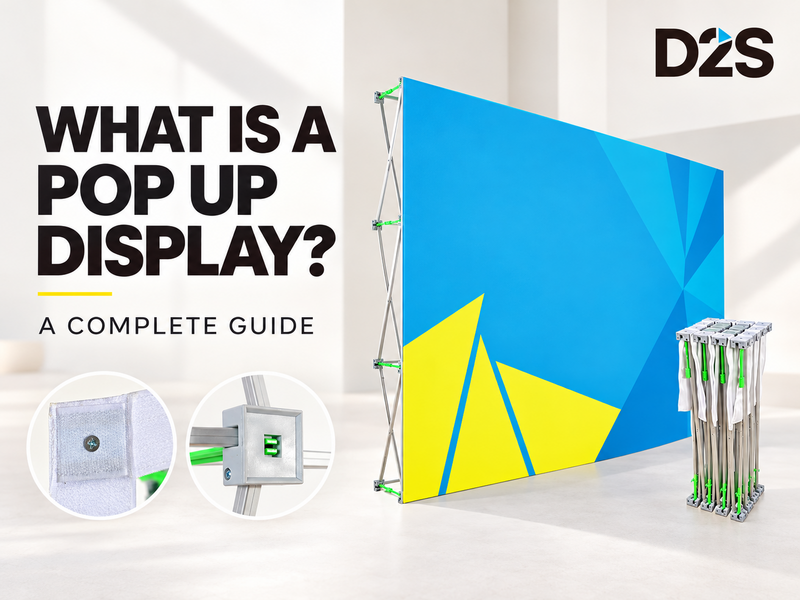
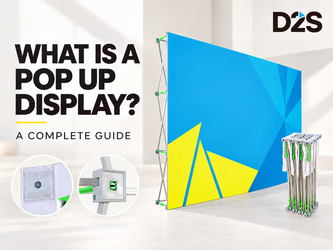
A pop up display is a portable display system built around a collapsible frame that expands into a larger backdrop or display wall.
Instead of assembling the main structure from many individual frame sections, the connected frame opens outward and locks into its display position. After the event, it collapses again for transportation and storage.
This simple structure is why pop up displays have remained common at trade shows, conferences, recruiting events, retail promotions and other temporary events.
They are especially useful when the project needs a relatively large branded surface without moving into a more complex modular booth system.
The important point is that “pop up” describes how the frame works. It does not describe one specific graphic material or one fixed display size.
How Does a Pop Up Display Work?
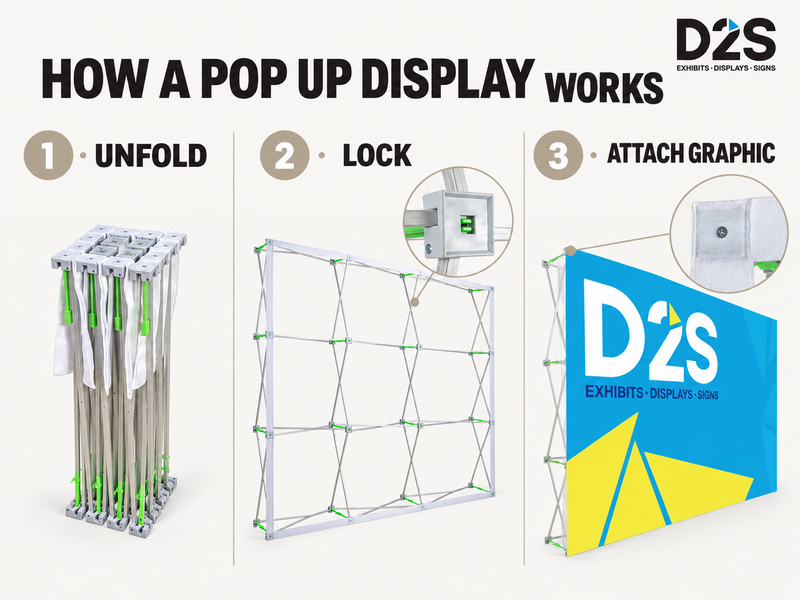
The main component of a pop up display is an expandable frame.
When stored, the frame contracts into a relatively compact structure. During setup, it is expanded horizontally and vertically until it reaches its finished dimensions.
Depending on the specific system, additional supports or locking components may then secure the structure.
The graphic is installed on or around this expanded frame.
A typical setup process is:
-
Remove the frame from its transport case.
-
Expand the connected frame.
-
Secure the frame in its open position.
-
Install or position the graphic.
-
Add any required feet, supports or accessories.
-
Position the finished display.
The major advantage is that the main frame remains connected between events.
There are fewer individual structural sections to identify and assemble compared with many conventional frame systems.
This makes the pop up display particularly suitable for situations where portability and straightforward deployment are more important than structural customization.
What Is a Pop Up Display Made Of?
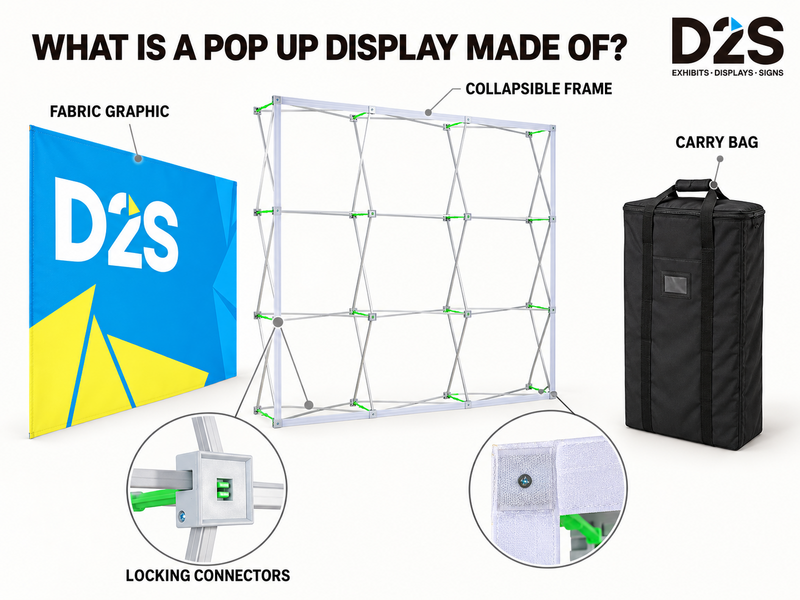
A pop up display usually consists of four main elements.
Collapsible Frame
The frame is the defining feature.
Many traditional pop up systems use an accordion-style structure made from connected frame sections.
As the structure expands, it creates the width and height needed to support the finished graphic.
Because the frame remains connected when collapsed, it can be stored without separating the structure into dozens of individual parts.
Graphic
Pop up displays can use different graphic systems depending on the product design.
These may include:
-
Fabric graphics
-
Graphic panels
-
Wraparound graphics
-
Tensioned fabric surfaces
This is one reason “pop up display” and “fabric display” should not be treated as opposite categories.
A pop up display describes the frame architecture.
A fabric display describes the graphic material or presentation method.
A product can be both.
Support Hardware
Larger backwalls may use additional feet, support components or stabilizers.
These help the expanded frame remain stable once installed.
Carrying Case or Bag
Because portability is a major part of the product concept, the packed display normally includes some type of transportation solution.
When comparing products, the packed dimensions can be just as important as the finished dimensions.
What Types of Pop Up Displays Are Available?
Pop up displays are available in several formats rather than one standard design.
The right format depends mainly on the amount of graphic area required and the role the display plays within the event space.
Pop Up Display Wall
A pop up display wall is a larger format designed to function as a backdrop.
It can create the primary branded surface in:
-
Trade show booths
-
Conferences
-
Corporate events
-
Recruiting fairs
-
Temporary retail environments
-
Promotional events
For a standard booth, the display wall may sit along the rear of the space with a counter or other portable displays positioned in front.
The main benefit is that a relatively large graphic wall can be packed into a much smaller format after the event.
If backdrop dimensions are still being planned, see What Size Trade Show Backdrop Do You Need? before choosing the final display width.
Portable Pop Up Display Stand
Not every project needs a full-width backdrop.
Smaller pop up displays can provide a compact branded surface for:
-
Product promotions
-
Reception areas
-
Retail activations
-
Event entrances
-
Supporting booth graphics
These displays are useful when floor space is limited or when the graphic needs to supplement a larger booth rather than create the main backwall.
Straight vs Curved Pop Up Displays
Pop up display walls may also use different finished shapes.
A straight display creates a flatter backwall and generally works well when the goal is to maximize usable booth depth.
A curved display creates a more dimensional presentation but can occupy more floor depth.
For D2S, where the focus is on practical portable display hardware, the important buying question is not simply which shape appears more interesting.
It is whether the structure fits the allocated booth space and the way the display will be transported and reused.
Fabric Pop Up Display vs Panel Pop Up Display
The graphic system can significantly change how a pop up display looks and operates.
Panel-Based Pop Up Display
Traditional systems may use individual printed graphic panels attached across the expanded frame.
This approach can be practical, but multiple panels can introduce:
-
Visible divisions between graphic sections
-
More rigid printed components
-
Additional graphic pieces to organize
-
More storage considerations
Fabric Pop Up Display
A fabric pop up display uses a textile graphic across the frame.
Depending on the design, this can provide a cleaner continuous visual surface while allowing the graphic to be packed more efficiently.
Fabric also changes the storage workflow because the graphic can generally be packed separately from the frame without requiring rigid panel storage.
If you are comparing these display categories, read Fabric Display vs Pop Up Display: Which Is Better?
That article focuses on the operational differences between fabric display systems and more traditional pop up structures.
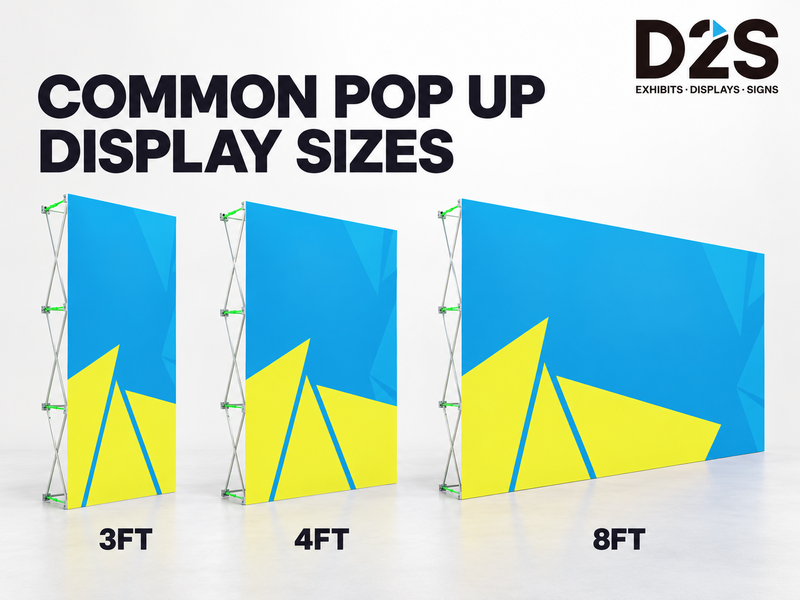
What Sizes Do Pop Up Displays Come In?
There is no single standard pop up display size.
Systems range from compact promotional stands to full trade show backwalls.
When choosing a size, start with the available space rather than the product catalog.
For a trade show booth, consider:
-
Booth width
-
Booth depth
-
Backdrop function
-
Visitor circulation
-
Counters and accessories
-
Event height restrictions
-
Transportation requirements
For example, a 10ft booth does not automatically require a display that fills every inch of the rear wall.
A slightly narrower backdrop may leave useful space for other hardware and can make the booth feel less crowded.
For a larger 10x20 booth, one large pop up wall is also not the only option. A smaller central backdrop combined with additional displays may create a more flexible layout.
The right size is the one that works with the complete booth, not simply the largest display that physically fits.
Are Pop Up Displays Easy to Transport?
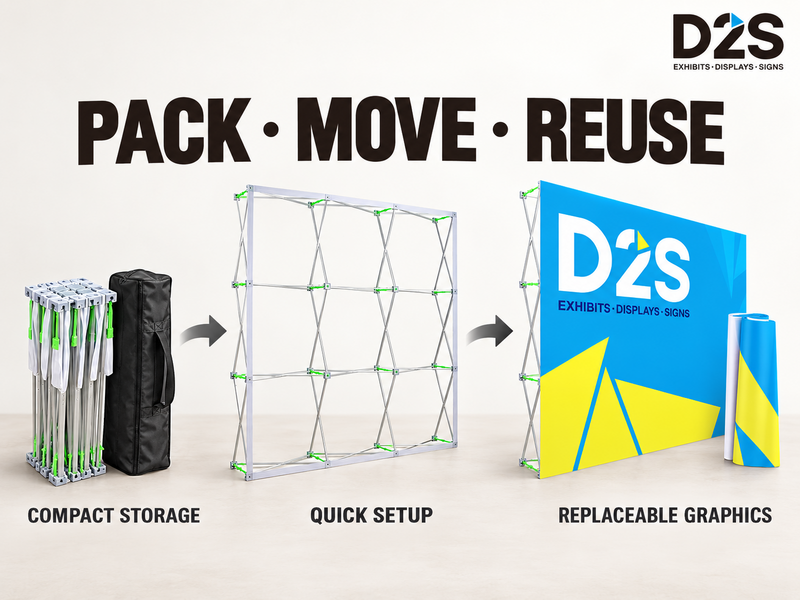
Portability is one of their main advantages.
Because the frame collapses, the packed footprint is substantially smaller than the finished display size.
This matters when hardware repeatedly moves through the same cycle:
storage → vehicle or carrier → venue → booth → teardown → storage
However, not all portable displays are equally efficient to transport.
When evaluating a pop up system, consider:
-
Packed frame dimensions
-
Frame weight
-
Number of packages
-
Graphic packing requirements
-
Carrying case dimensions
-
Whether one person can reasonably handle the package
For businesses managing several displays at once, these details can affect warehouse and logistics efficiency more than the installed appearance.
Are Pop Up Displays Reusable?
Yes, the hardware is designed for repeated use.
The useful life of the frame and the useful life of the graphic should be considered separately.
A company may keep the same frame while changing graphics because of:
-
Rebranding
-
New products
-
Seasonal campaigns
-
Different events
-
Different client requirements
For businesses handling repeated event projects, replacement graphic availability is therefore an important purchasing consideration.
Before choosing a system, confirm how graphics are attached and whether new graphics can be ordered independently of the hardware.
Pop Up Display vs Tension Fabric Display
These terms are often treated as direct alternatives, but technically they describe different things.
A pop up display is primarily defined by its collapsible frame.
A tension fabric display is primarily defined by how a fabric graphic is tensioned over or within a supporting structure.
That means some pop up displays can also use fabric graphics.
The more practical comparison is between the typical systems used in each category.
| Feature | Pop Up Display | Tension Fabric Display |
|---|---|---|
| Main characteristic | Collapsible frame | Tensioned fabric graphic |
| Frame | Expandable structure | Tube, extrusion or other frame |
| Setup | Expand frame | Assemble/open frame and install fabric |
| Graphic | Fabric or panels | Fabric |
| Packing | Compact frame | Depends on structure |
| Primary advantage | Simple portable deployment | Clean fabric presentation |
For a detailed buying comparison, read Fabric Display vs Pop Up Display: Which Is Better?
Display2Sign's broader Fabric Displays category also includes portable fabric walls, pop up displays, counters and other event display formats.
Pop Up Display vs Folding SEG Frame
A pop up display and a folding SEG frame can both solve the same general problem:
How do you create a large portable branded surface without carrying a permanent wall?
The way they solve it is different.
A pop up display uses an expandable frame.
A folding SEG frame uses an aluminum frame designed to fold while accepting a silicone edge graphic.
With SEG, the silicone strip sewn around the fabric edge is inserted into the frame channel, creating a tightly tensioned graphic surface.
| Feature | Pop Up Display | Folding SEG Frame |
|---|---|---|
| Frame concept | Expandable | Folding aluminum frame |
| Graphic system | Depends on product | SEG |
| Graphic edge | Depends on attachment | Tucked into frame channel |
| Portability | High | High |
| Standalone use | Strong | Strong |
| Modular potential | Limited by design | Greater with compatible systems |
The pop up display is particularly useful when a simple portable backdrop is the goal.
The folding SEG system becomes more attractive when the graphic finish and compatibility with a wider reusable frame system matter more.
For more detail, see What Is a Folding SEG Textile Frame Display?
Pop Up Display vs Roll Up Banner
Both are portable, but they serve very different visual roles.
A roll up banner is narrow and vertical.
A pop up display is usually wider and intended to create a larger background or branded wall.
Choose a roll up banner when you need:
-
Directional messaging
-
A narrow promotional graphic
-
Supporting booth branding
-
Very compact portable hardware
Choose a pop up display when you need:
-
A main backdrop
-
More graphic coverage
-
A stronger visual background
-
A wider branded surface
They can also be used together.
A pop up display can form the rear wall while roll up banners support specific product messages elsewhere in the booth.
Pop Up Display vs Modular Booth System
A pop up display is primarily a standalone portable display.
A modular booth system is intended to create a larger environment.
This becomes important once a project requires:
-
Multiple walls
-
Corners
-
Storage rooms
-
Connected structures
-
Counters
-
Different configurations between events
A pop up display works well when the project can be solved with one main backdrop.
If the same hardware must become a 10x10 booth for one event and a different 10x20 configuration later, modular hardware usually offers more flexibility.
This does not make a pop up display inferior.
It simply means the two systems solve different levels of project complexity.
When Is a Pop Up Display a Good Choice?
A pop up display makes sense when:
-
You need one primary portable backdrop.
-
Setup should remain straightforward.
-
The hardware will travel regularly.
-
Compact storage matters.
-
The booth does not require extensive structural customization.
-
A full modular system would add unnecessary complexity.
This makes pop up displays especially practical for standardized event programs where the basic display format remains consistent.
When Should You Consider Another Display System?
Another display may be more suitable when your priorities change.
Choose a Tension Fabric Display When:
A clean fabric presentation and lightweight graphic handling are more important than using a traditional expandable frame.
Choose a Folding SEG Frame When:
You want a portable structure with a defined SEG graphic channel and the hardware may need to integrate into a broader SEG display system.
Choose a Folding Light Box When:
The display needs portable LED illumination.
Choose a Modular SEG Light Box When:
The hardware needs to support illuminated booth walls or multiple configurations rather than one standalone portable backdrop.
The correct choice depends on the operational requirement rather than simply which product looks more advanced.
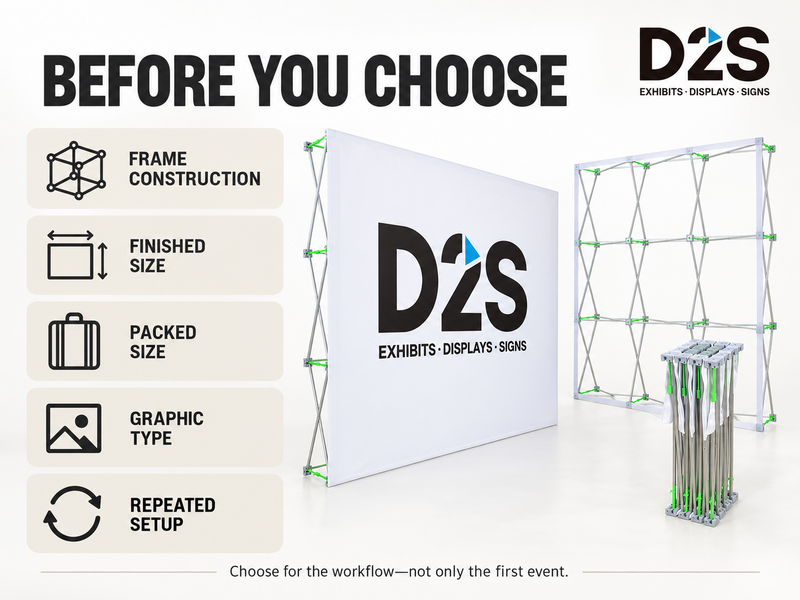
What Should You Check Before Buying a Pop Up Display?
For B2B buyers, the initial product price should not be the only evaluation point.
Check the complete operating workflow.
Frame Construction
The frame will be opened and closed repeatedly.
The connection points and locking structure therefore matter for long-term use.
Finished Size
Confirm that the display fits the actual event space and leaves enough room for other booth components.
Packed Size
A portable display is only genuinely practical if the packed hardware works with your transportation and storage process.
Graphic Type
Understand whether the display uses fabric or individual panels and how easily graphics can be replaced.
Replacement Graphics
If the hardware will be reused, confirm that graphics can be reordered independently.
Storage
Consider how many complete display systems can be stored efficiently.
This becomes particularly important for printers, exhibit suppliers and rental inventories.
Repeated Setup
Think beyond the first event.
A small inconvenience in the installation process becomes much more important when repeated across dozens of projects.
What Should Rental and Display Companies Consider?
A company buying inventory for multiple customers has different priorities from an exhibitor buying one backdrop.
For inventory use, ask:
Can the hardware support multiple projects without creating unnecessary operational complexity?
Important factors include:
-
Standardized sizes
-
Replacement graphic availability
-
Frame durability
-
Packing efficiency
-
Warehouse footprint
-
Ease of identifying complete sets
-
Compatibility between hardware and graphics
A simple, standardized pop up system can be valuable when customers frequently request straightforward portable backwalls.
When clients increasingly request different booth layouts, illuminated walls or premium SEG graphics, a broader modular system may be more useful.
The product mix should reflect the type of projects the business actually handles.
Are Pop Up Displays Still Relevant?
Yes.
Newer portable display systems have introduced folding aluminum frames, SEG graphics and modular configurations, but that does not eliminate the use case for pop up displays.
Pop up systems continue to solve a straightforward requirement:
create a large branded backdrop from compact portable hardware without building a complex booth.
For projects where that is exactly what is needed, additional structural complexity does not necessarily provide more value.
The key is understanding when the project has outgrown the pop up format.
Pop Up Display FAQs
What is a pop up display?
A pop up display is a portable exhibition display built around a collapsible frame that expands into a larger display wall or backdrop.
What is a pop up display used for?
Pop up displays are commonly used for trade shows, conferences, corporate events, recruiting fairs, retail promotions and other temporary branded environments.
Can a pop up display use fabric graphics?
Yes. Pop up refers to the frame structure, so some pop up displays use fabric graphics while others use separate graphic panels.
Are pop up displays reusable?
Yes. The frame can be used for repeated events, and many systems allow replacement graphics to be ordered separately.
What is the difference between a pop up display and a fabric display?
Pop up primarily describes a collapsible frame structure, while fabric display describes a broader category of displays using textile graphics. A pop up display can therefore also be a fabric display.
What is the difference between a pop up display and a folding SEG frame?
A pop up display uses an expandable frame, while a folding SEG frame uses a folding aluminum structure with a channel for silicone edge graphics.
Is a pop up display suitable for a 10x10 trade show booth?
Yes. A pop up backdrop can work well as the main graphic wall in a standard 10x10 booth, provided its finished dimensions comply with the event rules and leave enough usable booth space.
Final Thoughts
A pop up display is not defined by a particular graphic or booth size.
Its defining feature is the collapsible frame that expands into a larger display structure and packs down again after use.
That makes it useful when a project needs:
-
A substantial branded surface
-
Portable hardware
-
Straightforward setup
-
Compact storage
-
Repeated event use
The main limitation is configuration flexibility.
A pop up system is most efficient when it continues to perform roughly the same role from one event to the next.
When the hardware needs to support connected walls, multiple booth configurations, SEG graphics or illumination, other frame systems may be more appropriate.
For portable event hardware, explore Display2Sign Fabric Displays, including pop up displays, fabric walls and other reusable trade show display formats.