
What Size Trade Show Backdrop Do You Need?
Posted by Kira on Sep 9th 2026
What Size Trade Show Backdrop Do You Need?
Choosing a trade show backdrop is not simply a matter of buying the largest display that fits the booth.
The right backdrop size depends on how much of the booth you want to cover, where visitors enter, how the display will be transported and whether the same hardware needs to work across multiple events.
For a standard 10ft-wide booth, an 8ft to 10ft-wide backdrop will often provide the main branded wall without making the space feel overcrowded.
For a 20ft-wide booth, a 10ft backdrop can create a focused branded section, while a 20ft backdrop can create a full-width visual wall.
But booth width is only the starting point.
Before selecting a backdrop, consider:
-
Booth dimensions
-
Backdrop width and height
-
Visitor flow
-
Graphic visibility
-
Display type
-
Transportation
-
Storage
-
Reuse across different events
The best backdrop is not necessarily the one that fills every available inch.
It is the one that supports the booth layout while remaining practical to use repeatedly.
Quick Answer: What Size Trade Show Backdrop Should You Choose?
A simple starting point is:
| Booth Space | Typical Backdrop Approach | Best For |
|---|---|---|
| 10ft × 10ft | 8ft–10ft wide backdrop | Standard inline booths |
| 10ft × 20ft | 10ft or 20ft wide backdrop | Larger linear booths |
| 20ft × 20ft+ | Multiple backdrops or modular walls | Larger exhibit layouts |
| Small event area | 3ft–5ft portable display | Supporting branding |
For most standard 10ft-wide booth spaces, an 8ft or 10ft backdrop provides enough branding area without requiring a larger structural system.
A 20ft backdrop becomes more useful when the booth itself is wider and the graphic wall needs to create a continuous branded environment.
However, exact booth rules vary by event and venue, so always confirm the organizer's permitted display dimensions before ordering hardware or graphics.
Start With the Booth Size, Not the Backdrop
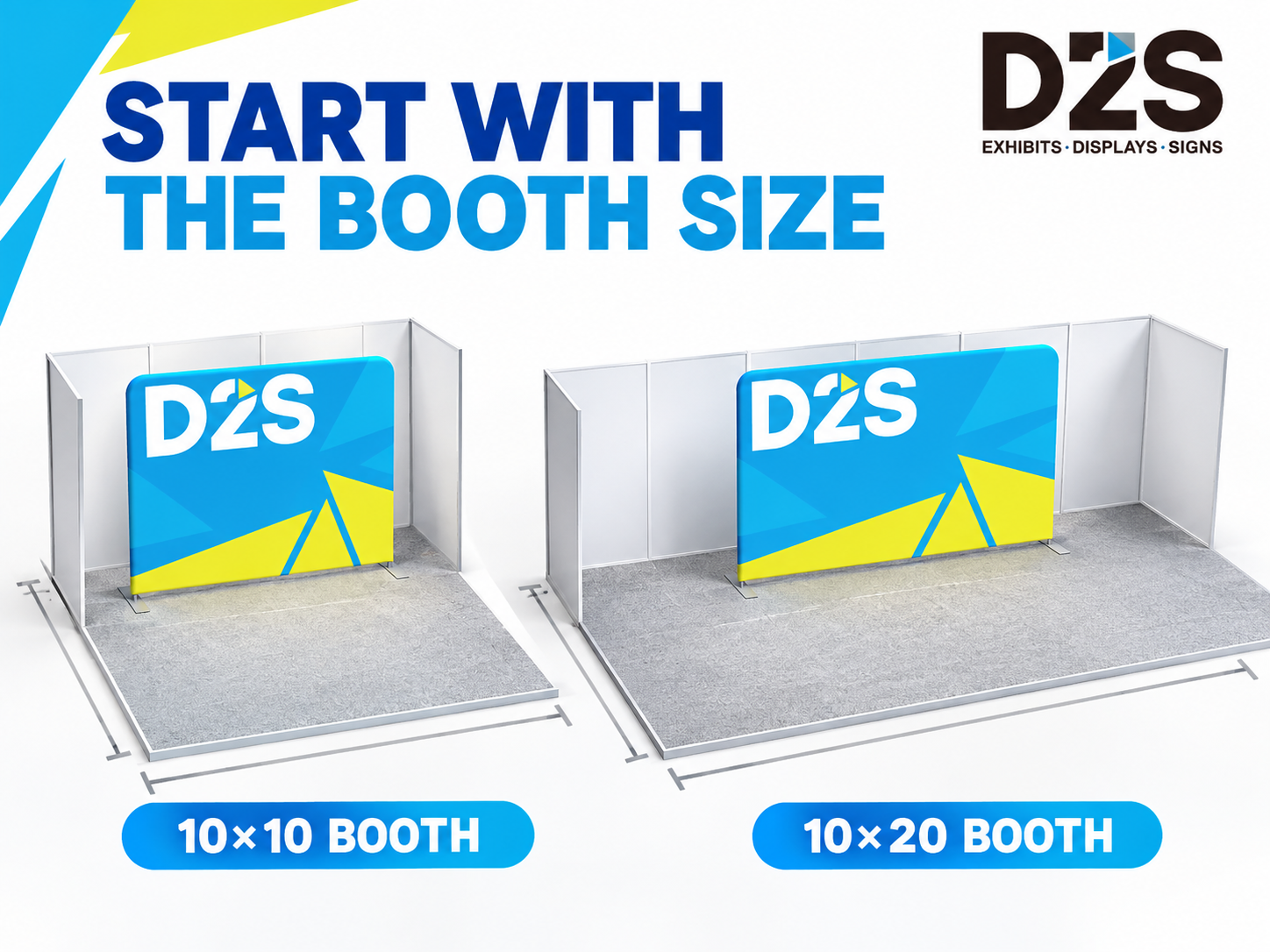
The most common mistake is choosing the display first and thinking about the booth layout later.
Instead, start with the allocated exhibit space.
Ask:
How much usable width do we actually have?
Then decide how much of that width should be occupied by the backdrop.
A 10ft booth does not automatically require a 10ft display.
Likewise, a 20ft booth does not always need a full 20ft wall.
Your booth may also need space for:
-
Counters
-
Product displays
-
Demonstration areas
-
Literature stands
-
Storage
-
Visitor circulation
-
Side graphics
The backdrop should support these elements rather than compete with them.
What Size Backdrop Works for a 10x10 Trade Show Booth?
A 10ft × 10ft booth is one of the most familiar trade show layouts.
For this space, an 8ft to 10ft-wide backdrop is usually the most practical starting range.
8ft-Wide Backdrop
An 8ft backdrop leaves some open space on either side within a 10ft booth.
This can make the booth feel slightly more open and gives you flexibility for:
-
Side accessories
-
Literature stands
-
Small product displays
-
Cable access
-
Easier positioning
An 8ft x 8ft EZ Fabric Display Wall can work well when you need a substantial graphic wall without covering the entire booth width.
An 8ft-wide backdrop can also be easier to manage when the same hardware will be used for conferences, corporate events or other environments outside the trade show booth.
10ft-Wide Backdrop
A 10ft backdrop creates a more complete visual wall across the rear of a standard 10ft booth.
This works especially well when:
-
The backdrop is the primary branding element.
-
You want maximum graphic area.
-
There are few accessories positioned beside the backwall.
-
The display is intended specifically for 10ft-wide spaces.
The 10ft x 8ft EZ Fabric Display Wall is designed as a full-size portable tension fabric backdrop for trade shows and events.
For many straightforward 10x10 booth layouts, this creates a simple structure:
backdrop + counter + open visitor space
without requiring a complete modular exhibit system.
Should You Choose an 8ft or 10ft Backdrop for a 10x10 Booth?
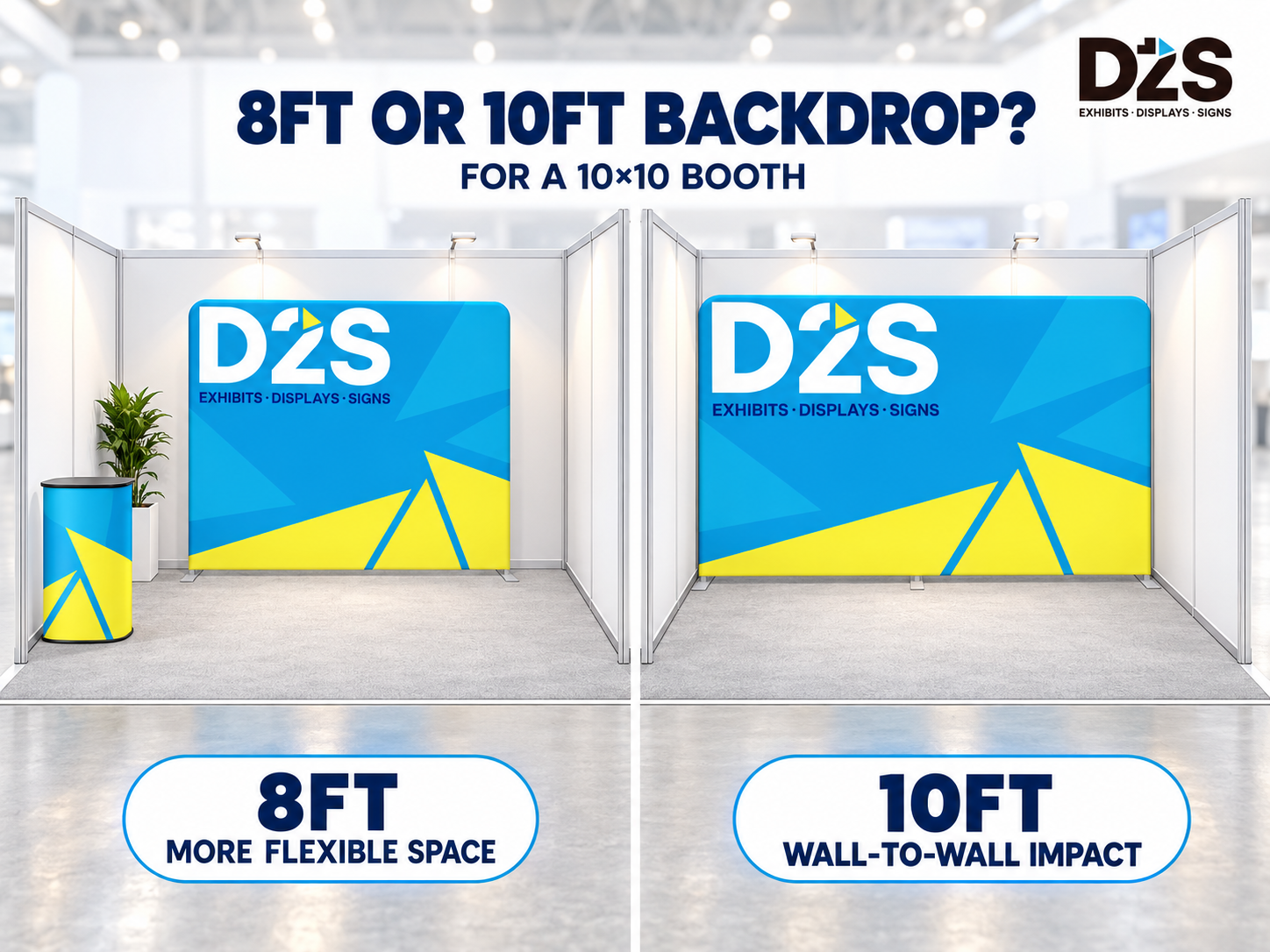
Neither size is automatically better.
Choose an 8ft backdrop when:
-
You want more open space at the sides.
-
The hardware will be used in different environments.
-
Portability is especially important.
-
The backdrop does not need to fill the full booth width.
Choose a 10ft backdrop when:
-
The backdrop is the main visual feature.
-
You want stronger wall-to-wall branding.
-
The booth layout is simple.
-
The hardware will frequently be used in 10ft spaces.
The decision should come from the booth layout, not simply from the available product size.
What Size Backdrop Works for a 10x20 Trade Show Booth?
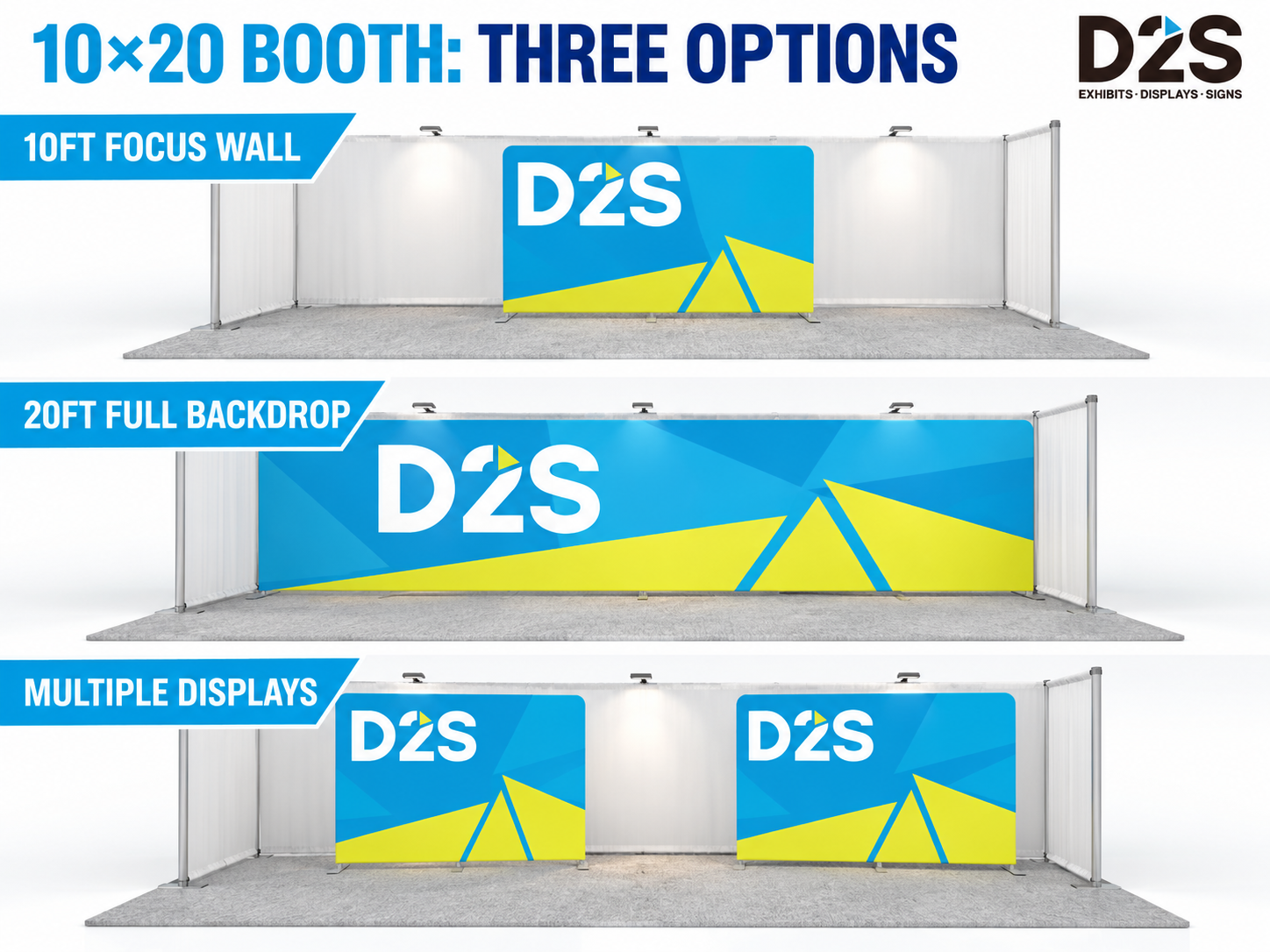
A 10ft × 20ft booth gives you more options.
You do not necessarily need one continuous 20ft backdrop.
There are three common approaches.
Option 1: Use a 10ft Backdrop
A 10ft backdrop can anchor one section of the booth while leaving the rest of the space open for:
-
Product demonstrations
-
Meeting areas
-
Counters
-
Freestanding displays
-
Additional branding
This approach can make sense when the booth needs functional space rather than one large graphic wall.
Option 2: Use a 20ft Backdrop
A 20ft backdrop creates a continuous branded wall across a larger space.
This works well when:
-
The backwall is the dominant visual feature.
-
Large-format artwork is important.
-
The booth needs stronger visual continuity.
-
The structure will be reused in similar large spaces.
Display2Sign's Fabric Displays include portable fabric wall options up to 20ft wide for larger exhibit applications.
Option 3: Use Multiple Smaller Displays
Instead of one large wall, you can use several independent frames.
For example:
-
Two 5ft panels
-
Multiple SEG frames
-
A central backdrop with side displays
This can provide more flexibility when the same hardware needs to support different booth sizes later.
For businesses managing rental inventory or multiple client projects, modularity may be more valuable than having one fixed 20ft structure.
Is an 8ft-High Trade Show Backdrop Tall Enough?
For many portable trade show backdrops, approximately 8ft is a practical height because it creates a substantial branded surface while remaining compatible with many standard portable display systems.
But height should never be chosen without checking event regulations.
Trade show organizers may impose rules covering:
-
Maximum display height
-
Sidewall height
-
Hanging signs
-
Sight lines
-
Booth type
-
Neighboring exhibitor visibility
Your hardware may physically support a certain height while the event rules permit something different.
Always confirm the exhibitor manual before finalizing the display.
From a visual perspective, height also affects how the artwork is designed.
The top section of the backdrop is often the most visible from farther away, so important branding should not be concentrated only near eye level.
Backdrop Width Matters More Than Simply Filling the Booth
It is easy to assume that a backdrop should always match the complete width of the booth.
That is not always the best approach.
The display needs to leave room for people and other booth components.
Imagine a 10ft-wide booth with:
-
A full-width backdrop
-
A counter
-
Two roll-up banners
-
Product displays
-
Seating
Technically, all the pieces may fit.
Visually and operationally, the booth may feel crowded.
A slightly narrower backdrop can sometimes create a cleaner layout.
This is why backdrop size should be considered together with the complete booth plan.
If you are still deciding how the overall exhibit should be structured, read How to Choose the Right Trade Show Booth for Faster Setup.
What Size Backdrop Is Best for Photography and Media Walls?
A trade show backdrop is not always used as the rear wall of a booth.
It may also serve as:
-
A photo backdrop
-
A press wall
-
An interview background
-
A conference stage element
-
A product-launch background
In these applications, width should be based on how many people need to appear in front of the graphic.
A narrow vertical display may be sufficient for one speaker or product.
A wider backdrop works better for:
-
Small groups
-
Interviews
-
Award presentations
-
Event photography
If people will frequently stand in front of the backdrop, avoid artwork that places important logos directly behind their heads or bodies.
Size and artwork planning should happen together.
What Size Backdrop Is Best for Portable Trade Show Use?
If portability is the priority, bigger is not always better.
Larger displays usually mean:
-
More frame components
-
Larger graphics
-
More packing volume
-
More weight
-
More storage space
A company attending several events per month may get more value from an 8ft or 10ft portable backdrop than from a 20ft system that requires more handling.
Ask how the display will actually move:
warehouse → vehicle → venue → booth → teardown → storage
If one or two people regularly handle the hardware, compact dimensions may be especially important.
For portable fabric systems, explore Display2Sign Fabric Displays.
Does the Type of Backdrop Change the Size You Should Choose?
Yes.
Two backdrops with the same finished dimensions can behave very differently depending on the frame system.
EZ Fabric Display Wall
An EZ fabric wall typically uses an aluminum tube structure with a stretch fabric graphic.
This format works well when you want:
-
A simple freestanding backdrop
-
Lightweight transportation
-
Straightforward installation
-
A large continuous fabric graphic
Display2Sign currently offers EZ Fabric Display Walls in several widths, including 8ft, 10ft and larger formats.
These are useful for standard portable backwall applications.
Pop Up Display
A pop up display uses a collapsible frame that expands into position.
This makes it useful when compact packing and quick deployment are priorities.
Pop up displays can work as:
-
Main backdrops
-
Supporting walls
-
Smaller promotional displays
If you are comparing pop up and fabric systems, read Fabric Display vs Pop Up Display: Which Is Better?.
Folding SEG Frame
A folding SEG frame uses a folding aluminum structure with silicone edge graphics.
This system is useful when a clean SEG graphic finish and reusable frame hardware are important.
Display2Sign offers SEG Folding Single Frames in multiple widths that can work independently or as part of larger booth configurations.
For a full explanation of the system, read What Is a Folding SEG Textile Frame Display?.
SEG Light Box
A light box adds LED illumination behind the graphic.
In this case, size affects more than physical coverage.
A larger illuminated wall can become a major visual element within the booth, but the system may also require more packing and structural components than a simple fabric backdrop.
If lighting is part of the decision, read SEG Light Box vs Folding SEG Frame: Which Is Better?.
Should You Use One Large Backdrop or Multiple Smaller Frames?
This is an important question for B2B buyers.
A single large backdrop gives you:
-
Fewer visual breaks
-
One continuous graphic
-
Strong large-format branding
-
A simple finished appearance
Multiple smaller frames give you:
-
More configuration options
-
Easier replacement of individual components
-
Greater flexibility across different booth sizes
-
Better inventory reuse
For a business purchasing one display for one standardized booth, a large fixed-width backdrop may be perfectly practical.
For an exhibit company, print shop or rental operation managing many different client requirements, multiple reusable frames may create more long-term flexibility.
For example, separate 5ft frames may be used individually for smaller events or combined into larger layouts when more display width is required.
The purchasing decision should therefore consider not only today's event but also how the hardware might be used six months or a year later.
How Much Space Should You Leave Around a Trade Show Backdrop?
There is no single required amount of side space for every booth.
Instead, consider what needs to happen around the display.
Leave additional space when:
-
Visitors need to move around the sides.
-
Cables or power access are required.
-
Side accessories will be installed.
-
The backdrop is not positioned directly against the rear boundary.
-
Multiple display elements need to share the booth.
A backdrop that technically fits but makes the rest of the booth difficult to use is too large for that layout.
Think in terms of usable booth space, not just maximum dimensions.
What If You Attend Different Booth Sizes During the Year?
This is where hardware planning becomes more important.
A business may attend:
-
One event with a 10x10 booth
-
Another with a 10x20 booth
-
A conference with a smaller promotional area
-
A corporate event outside a traditional booth space
Buying completely different hardware for every event can create unnecessary inventory.
Instead, consider whether a display system can be reused or combined.
For example, smaller SEG Folding Frames can provide more configuration flexibility than one permanently fixed large backdrop.
A modular system may require more planning initially, but it can reduce the number of separate hardware systems required over time.
Backdrop Size vs Graphic Design
Backdrop dimensions should influence artwork from the beginning.
Do not simply resize the same design for every display width.
For an 8ft Backdrop
Keep the message focused.
A logo, headline and a limited number of supporting visual elements can usually provide enough information.
For a 10ft Backdrop
You have more room to introduce:
-
Product imagery
-
Supporting graphics
-
Brand messages
-
Additional visual hierarchy
But avoid filling every part of the wall simply because more area is available.
For a 20ft Backdrop
A large graphic needs stronger composition.
Important elements should remain understandable from a distance.
Consider dividing the artwork into clear visual zones rather than stretching one small design across the full width.
Regardless of backdrop size, the primary brand message should remain easy to understand within a few seconds.
What Should Print Shops and Exhibit Suppliers Consider?
For professional display suppliers, backdrop size affects more than the customer's booth appearance.
It also affects production and inventory.
Before adding a new size to your offering, consider:
Graphic Production
Can your current printing and finishing workflow produce the required graphic efficiently?
Replacement Graphics
Are graphic specifications consistent enough for repeat orders?
Packaging
How many packages does the hardware require?
Warehouse Space
How much room does the system consume between projects?
Transportation
Can the hardware be shipped or carried efficiently?
Inventory Reuse
Can the same frame work for multiple customers or layouts?
A display size that sells well but creates operational problems may be less valuable than a more standardized system that can be reused across many projects.
How Should Rental Companies Choose Backdrop Sizes?
Rental inventory requires a different purchasing approach from one-time event buying.
Instead of asking:
“What size does this customer need?”
also ask:
“How many future projects can use this frame?”
Standardized portable sizes can make rental inventory easier to manage.
Smaller modular components can also offer advantages because they can be recombined across different layouts.
For rental programs, evaluate:
-
Frequency of demand
-
Storage density
-
Graphic replacement
-
Frame durability
-
Setup complexity
-
Compatibility between sizes
The goal is not simply to maximize the size of each display.
It is to maximize the useful life of the hardware.
Trade Show Backdrop Size Checklist
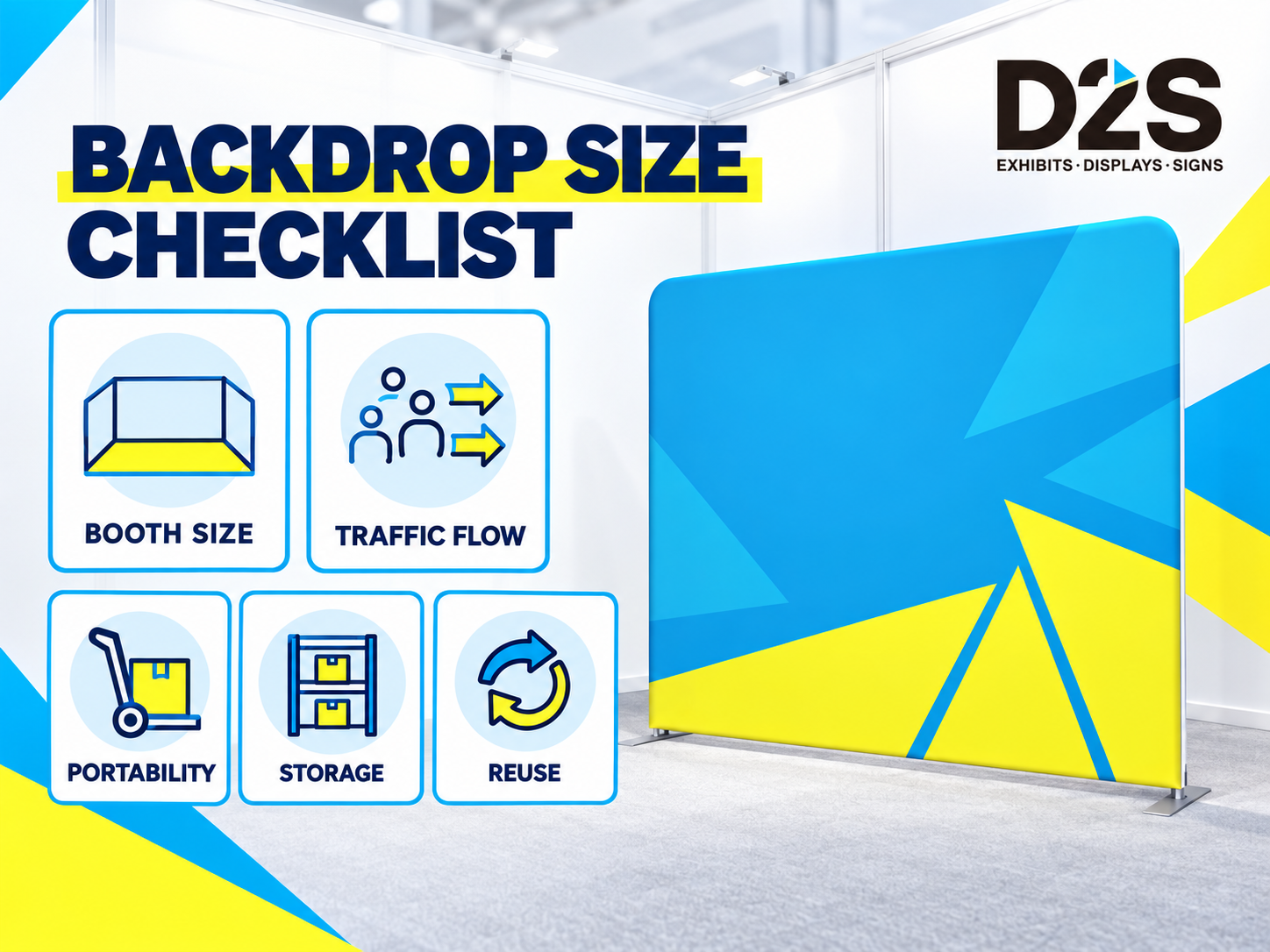
Before ordering a backdrop, confirm these seven points:
-
Booth width and depth
Know the actual exhibit space before selecting hardware. -
Event height restrictions
Confirm the exhibitor manual. -
Backdrop function
Decide whether it is the main wall, a secondary display or a photo background. -
Other booth components
Account for counters, product displays and visitor space. -
Transportation requirements
Consider packed size as well as finished size. -
Future event sizes
Determine whether the same hardware needs to work in different spaces. -
Graphic replacement strategy
Decide how frequently branding will change while the hardware remains in use.
These questions are usually more useful than choosing a backdrop based on width alone.
Trade Show Backdrop Size FAQs
What is the most practical backdrop size for a 10x10 booth?
An 8ft to 10ft-wide backdrop is a practical starting range for many 10x10 layouts. An 8ft display leaves more open side space, while a 10ft display creates a fuller backwall.
Will an 8ft backdrop work in a 10ft booth?
Yes. An 8ft backdrop can work well in a 10ft-wide booth and leaves additional space at the sides for accessories, circulation or other display components.
Do I need a 10ft backdrop for a 10ft booth?
Not necessarily. Choose the backdrop based on the complete booth layout rather than matching the booth width automatically.
What size backdrop should I use for a 10x20 booth?
A 10ft backdrop can create a focused display area, while a 20ft backdrop creates a larger continuous branded wall. Multiple modular frames are another option when flexibility matters.
Is an 8ft-high backdrop tall enough for a trade show?
An 8ft-high portable backdrop provides substantial graphic coverage for many exhibit applications, but the permitted display height depends on the specific event and booth type. Always check the exhibitor manual.
Is one large backdrop better than multiple small frames?
It depends on how the hardware will be used. One large backdrop creates a continuous graphic surface, while multiple smaller frames provide more flexibility for different booth sizes and future projects.
Final Thoughts
Choosing a trade show backdrop size starts with the booth space, but it should not end there.
For a typical 10ft-wide booth, an 8ft or 10ft backdrop can provide a practical balance between branding and usable space.
For larger 20ft environments, a 10ft focal backdrop, full-width 20ft wall or multiple modular frames can all work depending on the layout.
The more frequently the hardware will be reused, the more important portability, storage and configuration flexibility become.
Before buying, think through the complete lifecycle:
booth size → backdrop size → graphic production → transportation → setup → storage → reuse
That approach makes it easier to choose a display that works not only for the next event, but for future projects as well.
Explore Display2Sign Fabric Displays for portable backdrop options, or view SEG Folding Single Frames when modularity and reusable SEG hardware are the priority.