
What Is an SEG Light Box and Which Type Should You Choose?
Posted by Kira on Aug 19th 2026
Quick Answer: What Is an SEG Light Box?
An SEG light box is an illuminated display that uses LED lighting and a fabric graphic finished with a silicone edge.
SEG stands for Silicone Edge Graphic. A silicone strip is sewn around the edge of the fabric graphic and inserted into a channel in the light box frame. This creates a smooth, tensioned surface while the internal LED system illuminates the graphic from behind.
SEG light boxes are widely used for trade show backwalls, retail displays, branded environments, and modular exhibit booths.
The important point is that SEG describes the graphic installation method—not the entire light box structure. Different SEG light box systems can use different frame materials, connection methods, and modular designs.
How Does an SEG Light Box Work?
An SEG light box typically has four main components:
- Frame: Supports the structure and provides the channel for the graphic.
- LED lighting: Illuminates the graphic from inside the frame.
- SEG fabric graphic: A printed fabric graphic with silicone edging.
- Base or connection components: Allow the display to stand independently or connect with other modules.
The setup process is straightforward:
- Assemble or position the frame.
- Install or connect the LED lighting.
- Insert the silicone edge graphic into the frame channel.
- Connect the power supply.
The result is a bright, seamless display surface designed to attract attention from a distance.
For exhibit professionals, however, the setup process is only part of the decision. The structure behind the graphic can have a major impact on setup time, transportation, storage, and future reuse.
What Types of SEG Light Box Structures Are Available?
The U.S. market includes several common SEG light box structures.
Rather than thinking of every light box as the same product, it is more useful to compare them by how they are built.
| SEG Light Box Type | Typical Structure | Best For | Key Advantage |
|---|---|---|---|
| Traditional assembled light box | Aluminum extrusion | Retail and backwalls | Rigid structure |
| Modular aluminum light box | Connected aluminum modules | Exhibit houses and rentals | Expandable layouts |
| Preconfigured light box booth | Fixed or semi-modular kit | Specific booth sizes | Easy purchasing |
| Portable light box system | Portable frame with integrated components | Traveling events | Easier transportation |
| PVC modular light box | Connected PVC light box modules | Trade shows and rental fleets | Flexible configurations |
Traditional Aluminum SEG Light Boxes
Traditional SEG light boxes commonly use aluminum extrusion profiles.
The frame is assembled into a specific size, and the SEG graphic is installed around the perimeter.
This approach works well for:
- Retail environments
- Backlit trade show walls
- Permanent displays
- Projects where the configuration rarely changes
Its strength is structural rigidity. Its limitation is that larger systems may involve more individual frame pieces and hardware.
Modular Aluminum SEG Light Box Systems
Several U.S. exhibit suppliers offer modular aluminum systems designed to connect individual illuminated frames into larger environments.
Representative brands in this category include US-SEG and other modular exhibit suppliers.
These systems can typically create:
- Straight walls
- Corner booths
- Larger backlit environments
- Expanded exhibit configurations
For exhibit houses and rental companies, the key advantage is inventory reuse.
Instead of purchasing a completely different structure for every project, you can combine modules into different layouts.
Preconfigured SEG Light Box Booths
Another common approach is the preconfigured booth kit.
For example, a supplier may sell a complete:
- 10' × 10' booth
- 10' × 20' booth
- Corner booth
- Backlit wall
This is convenient when your client already knows the required booth size.
However, there is an important distinction between a modular booth kit and a fully reusable modular system.
Some booth kits can be expanded, while others are primarily designed for one configuration.
If you manage a rental fleet, that difference matters.
What Makes the Display2Sign SEG Light Box Different?
Display2Sign takes a modular approach using PVC light box modules with a 120 mm profile.
Our system is designed as more than a single illuminated backwall.
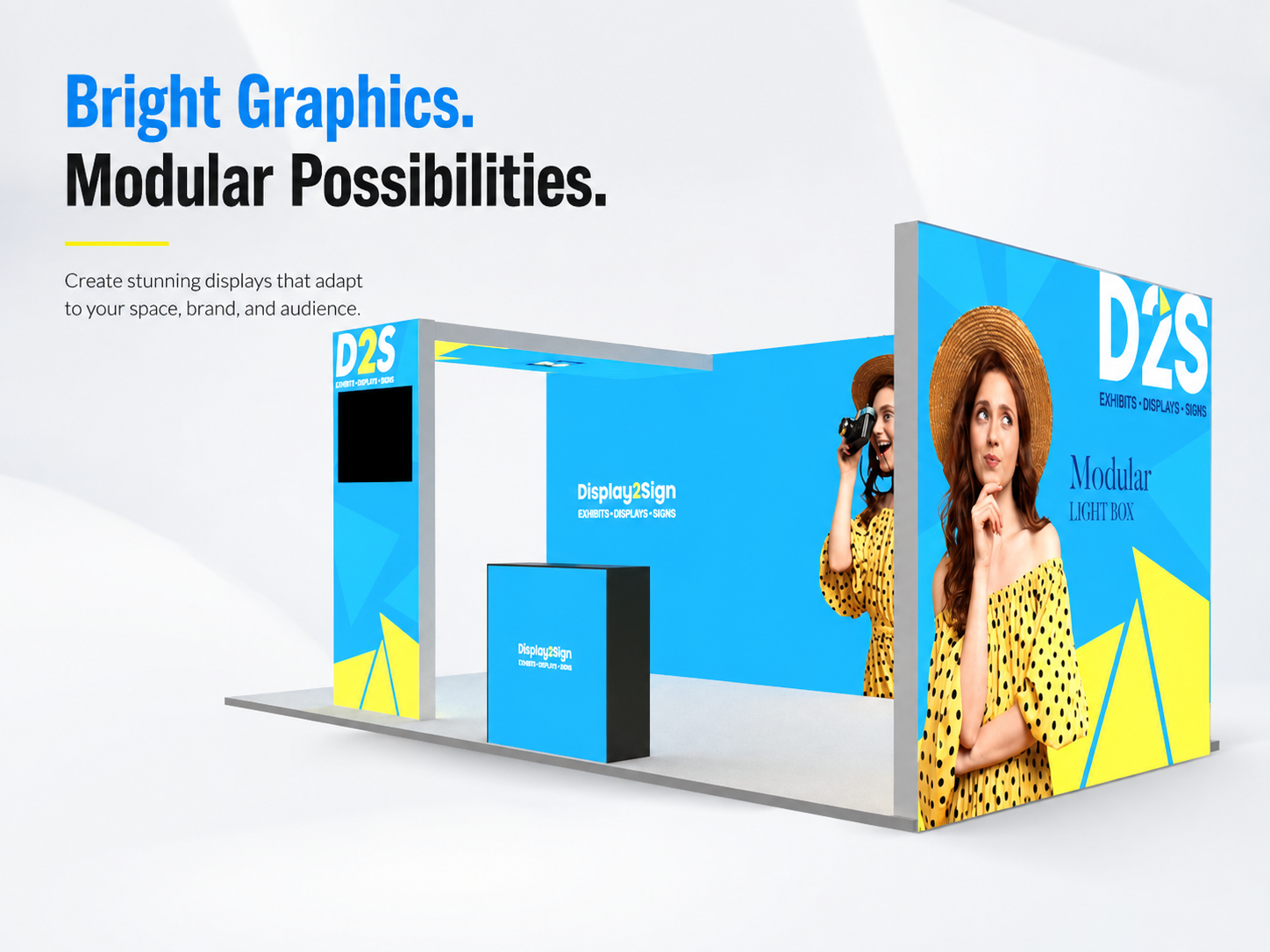
Individual modules can be combined to create:
- Trade show backwalls
- Modular booths
- Promotional counters
- 90-degree configurations
- Arch structures
- Larger exhibit environments
The system uses connection accessories to expand the possible configurations.
This allows you to approach exhibit inventory differently.
Instead of purchasing:
One booth for one event.
You can build a reusable system around:
One set of modules. Multiple booth configurations. New graphics when branding changes.
For exhibit houses and rental companies, that can make inventory more flexible over time.
Explore modular SEG Light Box Booth systems
Why Does the Light Box Structure Matter?
Two SEG light boxes can look similar from the front but behave very differently behind the graphic.
The structural design affects several practical factors.
Setup Time
A system with many loose frame pieces may require more assembly.
A modular system can simplify installation by using repeatable modules and connection components.
Transportation
Your clients may only see the finished booth.
Your operations team sees the shipping cases.
The size, weight, and packaging requirements of the system directly affect logistics.
Display2Sign's modular light boxes are packaged in Oxford bags with wheels, making them easier to move between warehouses, vehicles, and event venues.
Storage
For rental companies, display hardware must earn its space.
A system that supports multiple booth layouts can potentially generate more use from the same inventory.
Graphic Replacement
One of the biggest advantages of an SEG light box is that the hardware and graphics have separate lifecycles.
You can keep the frame and replace only the fabric graphic.
This makes SEG systems particularly useful for:
- Rental programs
- Seasonal campaigns
- Product launches
- Multi-client exhibit programs
Can an SEG Light Box Be Reconfigured?
That depends on the system.
A standard backlit frame may allow you to replace the graphic, but the physical structure may remain the same size.
A modular SEG light box can provide more flexibility.
With the appropriate modules and accessories, a system may be reconfigured from:
- A backlit wall
- To a corner display
- To a booth
- To a larger exhibit environment
This is where Display2Sign's PVC modular system is positioned.
The goal is not simply to create a reusable graphic display.
It is to create reusable exhibit hardware that can support different projects.
SEG Light Box vs Folding SEG Frame: What Is the Difference?
Both systems can use SEG fabric graphics, but they solve different problems.
| Feature | Folding SEG Frame | SEG Light Box |
|---|---|---|
| SEG Graphic | Yes | Yes |
| LED Lighting | No | Yes |
| Visual Impact | High | Very high |
| Portability | Excellent | Good |
| Setup Speed | Extremely fast | Depends on structure |
| Best For | Portable displays | High-impact exhibits |
A folding SEG frame is generally the better choice when fast setup and lightweight transportation are the priority.
An SEG light box is generally the stronger option when your client needs illumination and greater visual impact.
Learn more in What Is a Folding SEG Textile Frame Display?
A future comparison article can cover this topic in more detail:
SEG Light Box vs Folding SEG Frame
What Should You Consider Before Choosing an SEG Light Box?
For exhibit designers, printers, and rental companies, we recommend looking at five factors.
1. How Often Will the System Be Reused?
If the display is for a single event, a fixed configuration may be enough.
If it will be used across multiple clients or events, modularity becomes more important.
2. Does Your Client Need Different Booth Sizes?
If your clients regularly request 10' × 10', 10' × 20', or custom configurations, reusable modules may provide more flexibility.
3. How Important Is Setup Time?
Large exhibit structures can require more installation time.
Choose a system that matches the experience level of your installation team.
4. Can the Graphics Be Replaced Easily?
Confirm that your printing workflow is compatible with the required SEG fabric and silicone edge finishing.
5. Can the System Grow?
A good question to ask before purchasing is:
Can the hardware I buy today be used in a larger project next year?
For B2B buyers, this is often more important than the initial product price.
Why Are SEG Light Boxes Popular for Trade Shows?
SEG light boxes combine two important trade show advantages:
high visual impact and reusable hardware.
The LED illumination helps graphics stand out in busy exhibit halls.
The replaceable SEG fabric allows businesses to update branding without replacing the entire structure.
For exhibit houses and rental companies, modular systems add another advantage:
layout flexibility.
The same hardware can potentially support different clients, booth sizes, and event concepts.
That is why the conversation around SEG light boxes is shifting from:
"How bright is the display?"
to:
"How much can this system do?"
SEG Light Box FAQs
What is an SEG light box?
An SEG light box is an illuminated display that uses LED lighting and a silicone edge fabric graphic. The silicone edge fits into a frame channel to create a smooth, seamless display surface.
What does SEG stand for in an SEG light box?
SEG stands for Silicone Edge Graphic. The fabric graphic has a silicone strip sewn around its edge, allowing it to be inserted into a compatible frame.
Are all SEG light boxes made from aluminum?
No. Traditional SEG light boxes commonly use aluminum extrusion frames, but different systems can use different structural approaches. Display2Sign's modular SEG light box system uses PVC modules with a 120 mm profile.
Can you replace the graphics on an SEG light box?
Yes. The frame can be reused while the SEG fabric graphic is replaced with a new design.
Are modular SEG light boxes good for rental companies?
Yes, especially when the same modules can be reconfigured into different booth layouts. This can help rental companies increase the number of applications supported by the same hardware inventory.
What is the difference between an SEG light box and a regular fabric display?
An SEG light box includes LED illumination behind the fabric graphic. A regular tension fabric display typically relies on ambient lighting and does not include an internal lighting system.
Final Thoughts
An SEG light box is more than a backlit fabric graphic.
The structure behind the graphic determines how the system is assembled, shipped, stored, reused, and expanded.
Traditional aluminum frames, preconfigured booths, and modular systems all serve different purposes.
For Display2Sign, the focus is on a different level of flexibility: a 120 mm PVC modular light box system designed to help exhibit professionals build backwalls, booths, counters, arches, and other configurations from reusable modules.
For your clients and your rental fleet, the key question is not simply:
Do I need an SEG light box?
It is:
What kind of SEG light box system will continue to work for future projects?